



What Accounting Automation Software Actually Needs to Do for Audit Teams
Accounting automation transforms manual financial processes into structured, technology-driven workflows. But "automation" covers a wide range of capabilities, and most tools on the market are built for bookkeeping teams, not audit teams. The distinction matters because audit work demands evidence-grade documentation, population-level coverage, and defensible risk assessment, not just faster data entry.
Automated Evidence Reconciliation vs. Basic Bank Sync
Basic bank sync matches transactions to bank statements. That is useful for a bookkeeper. Audit evidence reconciliation is different: it ties client-provided documentation to specific ledger entries, flags gaps, and produces a traceable record. Automated reconciliation software designed for audit teams handles multi-source evidence matching, not just one-to-one bank feeds. Tools without this capability require auditors to complete the reconciliation manually in Excel, which reintroduces the exact error risk automation is meant to remove.
Risk Scoring Coverage: Sampling vs. 100% of Transactions
Traditional audit uses sampling because manual testing of every transaction is not feasible. Invoice processing automation software and general ledger tools that flag only exceptions are not the same as ML-driven risk scoring across 100% of the transaction population. Full-population coverage changes what auditors can assert. Sampling-based tools still leave coverage gaps that require judgment to bridge. Audit teams evaluating erp financial software or standalone risk tools need to ask whether the tool tests all transactions or just the ones that breach a threshold.
Workpaper and Documentation Output: Structured or Still Manual
Financial statement software that produces reports is not the same as a workpaper engine. Audit-grade tools generate structured workpapers from testing results, pre-mapped to engagement templates and quality standards. Tools that only export data to PDF or Excel shift the documentation burden back to the auditor. The table below sets the evaluation criteria used throughout this article.
| Criterion | What Weak Tools Do | What Audit-Grade Tools Do |
|---|---|---|
| Evidence reconciliation | Bank feed matching, single-source | Multi-source matching tied to ledger entries with gap flagging |
| Risk scoring coverage | Exception flagging above a threshold | ML scoring across 100% of transactions |
| Workpaper output | Export to Excel or PDF | Structured workpaper generation mapped to engagement templates |
The 7 Best Accounting Automation Software Tools for Audit Teams
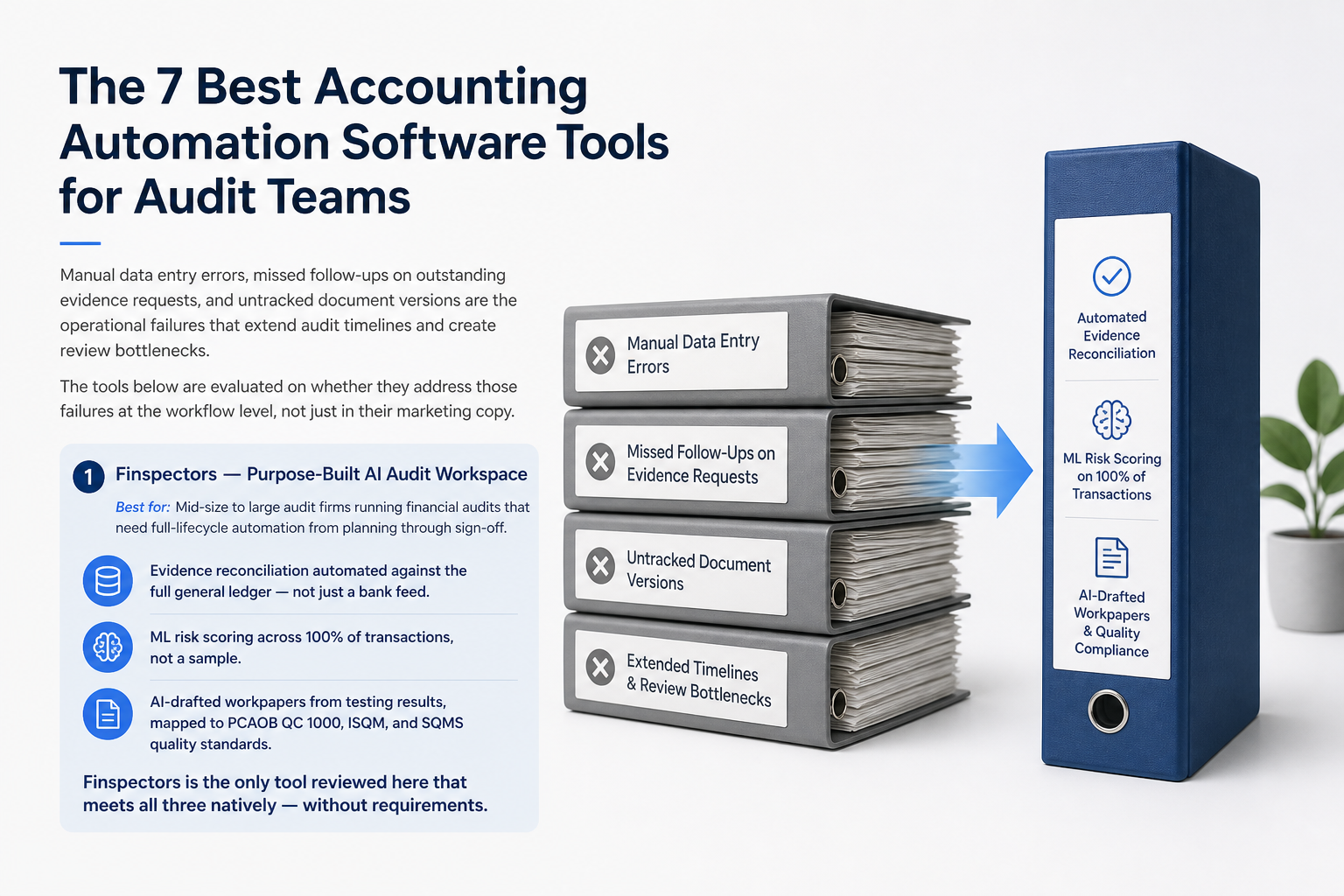
Manual data entry errors, missed follow-ups on outstanding evidence requests, and untracked document versions are the operational failures that extend audit timelines and create review bottlenecks. The tools below are evaluated on whether they address those failures at the workflow level, not just in their marketing copy.
1. Finspectors — Purpose-Built AI Audit Workspace
Best for: Mid-size to large audit firms running financial audits that need full-lifecycle automation from planning through sign-off.
Finspectors is purpose-built by chartered accountants and runs ML risk scoring across 100% of transactions, not a sample, with agentic AI agents covering the full audit lifecycle from planning through sign-off. Unlike tools that bolt audit features onto bookkeeping platforms, Finspectors integrates quality management natively so review and sign-off happen inside the same workspace where evidence is tested.
Against the three criteria from section one: Finspectors clears all three. Evidence reconciliation is automated against the full general ledger, not just a bank feed. Risk scoring covers the full transaction population using ML, not threshold-based exception flagging. Workpaper generation is AI-drafted from testing results, structured to engagement templates and mapped to PCAOB QC 1000, ISQM, and SQMS quality standards. Competitors on this list partially meet one or two criteria. Finspectors is the only tool reviewed here that meets all three natively, without requiring third-party add-ons or manual bridging steps.
Limitation: Finspectors is purpose-built for financial audit. Teams that primarily need bookkeeping automation or payroll processing will find the tool over-specified for those workflows.
2. CaseWare Working Papers — Structured Workpaper Automation
Best for: Established audit practices that need structured workpaper management and engagement file organization across multiple engagements.
CaseWare has long been the standard for workpaper structure in mid-size and large firms. It automates engagement file setup, cross-references financial statement software outputs, and maintains a structured audit trail across the engagement lifecycle. Workpaper templates are pre-built and role-based, which reduces the time auditors spend on documentation setup.
The limitation is evidence testing. CaseWare manages the workpaper container but does not automate evidence reconciliation or run risk scoring across transaction populations. Auditors still pull evidence manually and populate workpapers themselves. Implementation also carries a learning curve. Teams who have watched CaseWare demo walkthroughs frequently note that initial configuration and template mapping require dedicated setup time before the tool becomes productive.
Limitation: Not a risk scoring or evidence testing tool. Works best as the documentation layer on top of other audit procedures, not as a standalone audit automation platform.
3. AuditBoard — Risk and Evidence Management at Scale
Best for: Enterprise audit teams and internal audit functions managing large, multi-entity risk frameworks and SOX compliance programs.
AuditBoard centralizes risk assessment, control testing, and evidence management across complex audit programs. It is strong on gl reconciliation software integration and reporting, with dashboards that give audit leadership visibility across all active engagements. Workflow software for accountants at this scale benefits from AuditBoard's role-based assignment and review tracking.
The gap for external audit teams is transaction-level automation. AuditBoard manages the process around audit evidence but does not perform automated reconciliation at the transaction level or run ML risk scoring. Teams using AuditBoard for financial audit still conduct evidence testing manually. Users who have evaluated the platform note that setup complexity is significant: configuring risk frameworks and control libraries requires meaningful IT and project management investment before the tool is productive.
Limitation: Built for internal audit and enterprise risk management. External audit firms running financial statement audits will find it powerful for oversight but limited for evidence-level automation.
4. Thomson Reuters Checkpoint Edge with Audit Guidance
Best for: Audit teams that need authoritative technical guidance integrated into the engagement workflow, particularly for complex or judgmental areas.
Checkpoint Edge is not an evidence testing tool. It is a knowledge platform that delivers technical audit guidance, standard references, and practice aids within the research workflow. For accounting firm practice management software stacks, it fills the technical reference gap that pure workflow tools miss. Senior auditors and managers use it to research accounting treatments and support judgmental conclusions in workpapers.
The value is in decision support, not process automation. Checkpoint Edge does not reconcile evidence, score transactions, or generate workpapers. It answers the question of what the auditor should conclude, not how to test the evidence to reach that conclusion.
Limitation: Not an automation tool in the operational sense. Works as a complement to audit workflow platforms, not a replacement for evidence testing or workpaper generation capabilities.
5. MindBridge AI Auditor — ML-Driven Transaction Risk Scoring
Best for: Audit teams that want to move from sampling to full-population transaction analysis without replacing their existing workpaper platform.
MindBridge applies machine learning to the full general ledger population and scores every transaction for risk indicators including anomalies, unusual patterns, and control deviations. This directly addresses the sampling gap that traditional audit methods leave open. Financial report writer software and workpaper tools sit alongside MindBridge rather than being replaced by it.
The integration model is the main consideration. MindBridge outputs risk scores and flags that then need to be incorporated into the existing engagement workflow. Teams still need a separate workpaper platform and a process for translating MindBridge outputs into documented audit conclusions. It adds a powerful capability but does not deliver an end-to-end audit workflow.
Limitation: Requires integration with an existing audit platform to be fully effective. Teams without a structured workpaper environment may find the output difficult to operationalize without additional workflow investment.
6. QuickBooks Online (with Automation Add-Ons) — SME Audit Support
Best for: Smaller engagements where the client runs QuickBooks and the audit scope is limited to straightforward financial statement review.
QuickBooks Online is widely used for small and mid-sized business accounting, and its automation capabilities cover bookkeeping, invoicing, and basic reporting. For audit teams serving SME clients, access to a clean, automated client data environment reduces the time spent normalizing data before testing begins. Collections automation software integrations and bank feeds keep client records current, which helps auditors work from reasonably reliable source data.
This is client-side infrastructure, not audit-side automation. QuickBooks does not perform evidence reconciliation in the audit sense, does not score transactions for risk, and does not generate workpapers. Its value to audit teams is indirect: a client on QuickBooks Online with clean automated bookkeeping is easier to audit than one on a manual spreadsheet system.
Limitation: Not an audit tool. Useful only when the client uses it and the engagement is small enough that the auditor can work directly from the QuickBooks data environment.
7. Xero + Hubdoc — Document Capture and Reconciliation for Smaller Engagements
Best for: Sole practitioners and small audit firms handling straightforward engagements for SME clients where document collection is the primary workflow bottleneck.
Xero provides cloud-based accounting with strong bank reconciliation and reporting. Hubdoc adds automated document capture, pulling invoices and receipts from client email and supplier portals and matching them to Xero transactions. For smaller engagements, this combination reduces the evidence-gathering burden significantly. Automated reconciliation software at this level handles the document-to-transaction match that would otherwise require auditor time to chase and organize.
The ceiling is clear. Xero and Hubdoc are built for bookkeeping, and their reconciliation is designed to keep client records clean, not to produce audit evidence in a defensible format. Risk scoring is absent. Workpaper output does not exist natively. For audit teams, the combination works as a client-side data quality tool rather than an audit automation platform.
Limitation: No risk scoring, no workpaper generation, no audit trail in the sense required for financial statement audit documentation. Appropriate only for the smallest and most straightforward engagements.
How to Choose the Right Accounting Automation Software for Your Audit Practice
The most common mistake audit teams make when evaluating accounting automation is comparing tools on feature lists rather than on the specific workflow gap causing the most time loss. A tool that automates invoice capture does not help a team whose bottleneck is evidence reconciliation. A workpaper platform does not help a team whose problem is that risk assessment has no data foundation.
Match Tool Depth to Engagement Complexity
Decision prompt 1: How many transactions does your largest engagement type include per period?
- More than 10,000 transactions per engagement: Tools 1 (Finspectors), 3 (AuditBoard), or 5 (MindBridge) are the relevant tier. Only tools with full-population ML scoring provide meaningful coverage at this volume.
- Between 1,000 and 10,000 transactions: Tools 2 (CaseWare) and 3 (AuditBoard) suit this range if workpaper structure and evidence management are the primary need.
- Fewer than 1,000 transactions: Tools 6 (QuickBooks) and 7 (Xero + Hubdoc) are appropriate if the client's own data environment is the bottleneck, not the audit workflow itself.
Integration Fit: ERP, Practice Management, and QM Systems
Decision prompt 2: Do you need integrated workpaper output, or just risk flagging that feeds into your existing platform?
Accounting project management software and workflow accounting software already in your stack determine whether you need a full replacement or a point solution. Teams running CaseWare who want better risk coverage can add MindBridge without replacing their existing environment. Teams that want to consolidate into a single audit workspace with native quality management integration should evaluate whether their current stack can be replaced or must be extended.
Total Cost of Adoption vs. Time-to-Value for Audit Staff
Decision prompt 3: Are you replacing a legacy platform or adding automation to an existing stack?
Replacement decisions carry migration, training, and re-templating costs that point solutions avoid. The report writing software and digital reporting software outputs that audit teams rely on may need rebuilding in a new environment. Time-to-value for audit staff is shorter with point solutions but the long-term workflow fragmentation cost is higher. Teams that frequently rebuild workpapers from scratch each engagement are usually better served by a unified platform than by adding another integration layer.
What Does Accounting Automation Software Do in an Audit Context?
In an audit context, accounting automation software does more than streamline bookkeeping. It covers automated reconciliation of evidence against ledger entries, ML-based risk scoring across full transaction populations, structured workpaper generation from testing results, and financial statement validation with cross-referencing checks. The output is defensible, documented audit evidence rather than organized financial records.
Key capabilities that separate audit-context automation from general bookkeeping automation:
- Risk scoring at transaction level: Automated reconciliation software built for audit uses ML to flag anomalies, unusual patterns, and control exceptions across every transaction, not just those above a dollar threshold.
- Evidence reconciliation with audit trail: Invoice processing automation software designed for audit ties each piece of client evidence to a specific ledger entry and maintains a traceable record for review and sign-off.
- Structured workpaper output: Financial statement software for audit generates workpaper documentation from testing results, pre-mapped to engagement templates and quality standards, rather than exporting raw data for auditors to structure manually.
Conclusion
The tools on this list split into two categories. Some automate around the audit: they clean up client data, organize evidence folders, and speed up administrative tasks. Others automate the audit itself: they score risk across every transaction, reconcile evidence without auditor intervention, and generate structured workpapers from testing results.
If your team still manually matches evidence, rebuilds workpaper templates each engagement, or assesses risk by judgment without data coverage of the full transaction population, adding a bookkeeping automation tool will not close that gap. The bottleneck is audit-specific, and it requires an audit-specific solution.
If full-population risk scoring and integrated workpaper generation are the gaps your team needs to close, see how Finspectors runs the full audit lifecycle — request a walkthrough built around your engagement type.