



Excel Linkage: How to Audit Cross-Workbook Formulas Without Breaking Them
A senior auditor is three weeks into fieldwork when she notices a variance she cannot explain. The trial balance figures in the workpaper do not match the client's general ledger. After two hours of tracing, she finds the source workbook was renamed when the client reorganized a shared drive. Fourteen cross-workbook formulas silently broke that day. Excel never flagged an error. The manager reviewed cached values that looked correct and signed off.
This is not a skills problem. It is a structural problem with how audit teams rely on Excel linkage across multi-file workpaper sets. Broken links return stale values, not errors. Visual review does not catch them. And the consequences range from a wasted fieldwork day to a restatement.
This article gives you a step-by-step method to locate every external link in a workpaper, test each one safely, and harden your file structure before a broken path corrupts your evidence or triggers a regulator's question.
Why Excel Linkage Fails Silently in Audit Workpapers
Most Excel linkage failures are invisible until someone with institutional knowledge asks the right question. Understanding exactly how they occur helps you assess your own exposure before any fix is applied.
The three triggers that break an external link without warning
Three actions break an external link without producing an error message in the dependent workbook. First, renaming the source file changes the path Excel stored when the link was created. Second, moving the source file to a different folder or network location breaks the path even if the file name stays identical. Third, converting a shared network file to a locally saved copy severs the original network path entirely. None of these actions trigger a prompt in the workbook that still references the old path.
Why cached values hide broken links during review
When a source workbook is unavailable, Excel displays the last value it successfully pulled from that file. The cell looks populated. No error. No warning triangle. This is the cached value, and it is the reason broken Excel linkage survives manager review. The formula bar still shows the broken path, but reviewers checking cells by value rather than formula will not see it. A walkthrough of this behavior in Excel shows exactly this: a cell displaying a number that looks reasonable, while the formula behind it points to a file that no longer exists at that path.
How emailed workbook copies create phantom source files
When a preparer emails a workpaper to a colleague, the recipient saves the file locally. Any links inside that file now point to the sender's local drive path, which the recipient cannot access. The connection file reference becomes a phantom. Opening the workbook on a different machine returns cached values from the sender's last session. This is a common pattern when teams share additional files outside a central document management environment, and it is one reason what is ShareFile or similar centralized platforms exist in audit workflows.
Large-scale organizations have restated financial results after stale linked values fed incorrect figures into reported numbers without detection. The business consequence of cached values in financial reporting is not theoretical. It is the kind of error that compounds across quarters before anyone traces it back to a broken path.
How to Map Every Excel Linkage in a Workpaper File
Before testing any link, you need a complete inventory. Skipping this step means you are testing links you know about while trusting links you do not.
Using Edit Links to surface all external source files
In Excel, go to Data > Edit Links (Windows) or Data > Queries and Connections > Edit Links (Mac). This dialog lists every external workbook Excel recognizes as a source for the current file. For each source, you will see the file name, the update status, and whether Excel can currently locate the file. Change the status column: "OK" means the path resolves; "Error" means it does not. Run this check on every workpaper file before fieldwork begins, not after.
One important gap: Edit Links misses external references created through Power Query and some named ranges. To catch those, run a secondary search using Find and Replace. Press Ctrl+H, enter "[" in the Find field, and search within formulas. Any cell containing "[" in its formula holds an external reference. This catches formula-level Excel linkage that the Edit Links dialog omits.
Tracing precedents to identify which cells carry external references
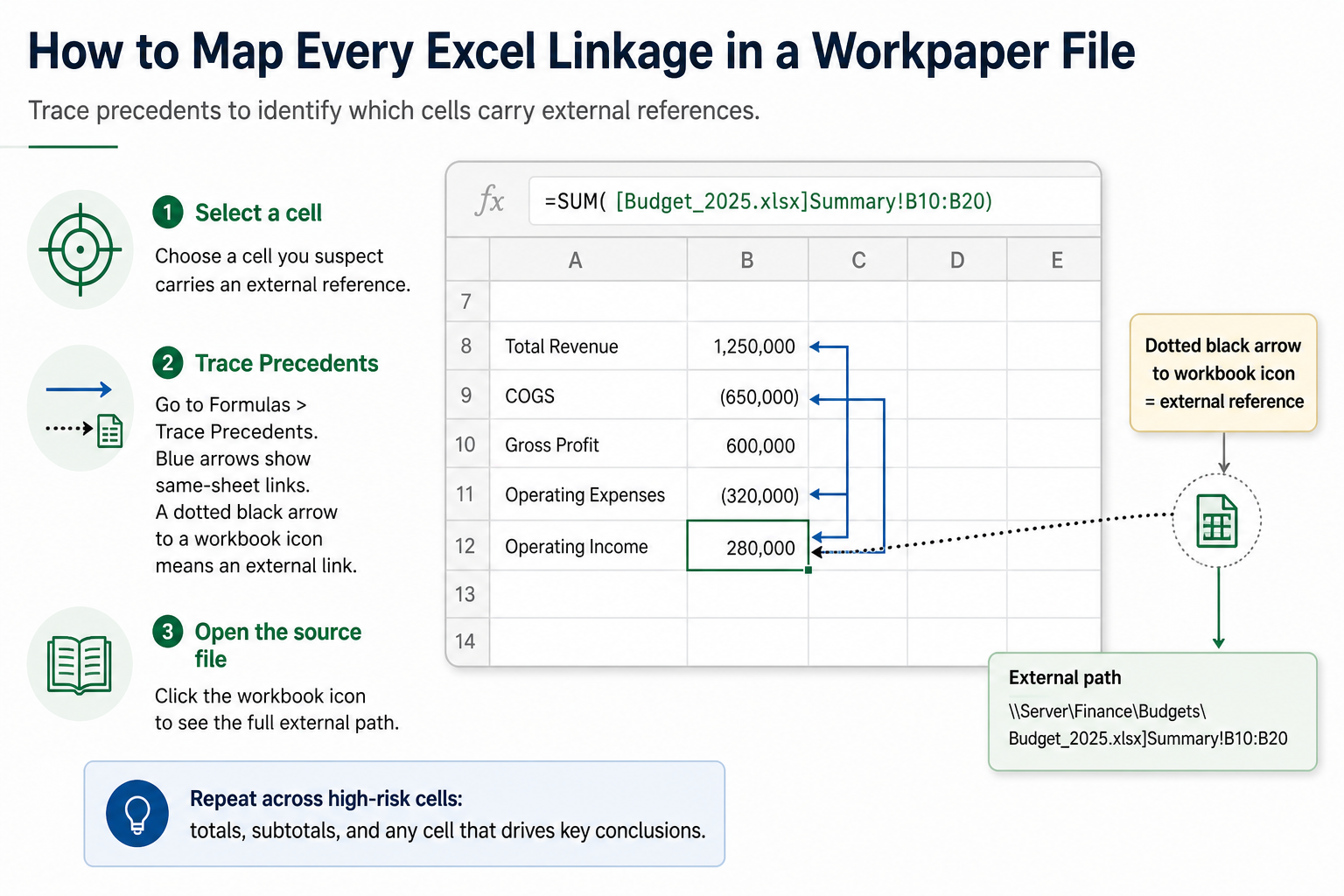
Select a cell you suspect carries an external reference, then go to Formulas > Trace Precedents. Blue arrows point to cells within the same sheet. A dotted black arrow pointing to a small workbook icon indicates the precedent is in another file. Click the icon to see the full external path. Repeat this across high-risk cells: totals, subtotals, and any cell feeding into a cashflow in Excel summary or a trial balance tie-out.
For larger workpapers with dozens of formulas, use Formulas > Show Formulas (Ctrl+`) to display every formula in the sheet at once, then scroll for cells containing "[". This is faster than tracing each cell individually, particularly when working with NetSuite exports to Excel or Great Plains reports that arrive with pre-built external references already embedded.
Building a link inventory log for workpaper documentation
Document every link you find in a structured log before touching any of them. This log becomes part of your workpaper evidence and gives the reviewing partner a clear picture of file dependencies.
| Source File | Linked Cell | Formula Preview | Status |
|---|---|---|---|
| TB_FY25_v3.xlsx | Summary!B12 | =[TB_FY25_v3.xlsx]Sheet1!$D$14 | Active |
| Cashflow_Q4.xlsx | CF!C7 | =[Cashflow_Q4.xlsx]Model!$B$22 | Broken |
| Revenue_Supp.xlsx | Rev!F4 | =[Revenue_Supp.xlsx]Detail!$A$9 | Unverified |
Source File identifies the workbook Excel is pulling from. Linked Cell is the address in your workpaper where the value lands. Formula Preview shows the raw formula so the reviewer can verify the exact path. Status records whether the link was confirmed active, broken, or not yet tested. Update status only after completing the test procedure in the next section.
A Step-by-Step Process to Test Excel Linkage Without Breaking It
Testing a link safely means verifying it resolves to the correct current value without accidentally overwriting a prior-period snapshot stored in the source file. The sequence below prevents both problems.
Step 1: Open source files in read-only mode before refreshing. Navigate to File > Open, locate the source workbook, click the dropdown arrow next to the Open button, and select Open Read-Only. This prevents Excel from triggering any auto-calculation or save event in the source file. Clicking "Update" on a linked workbook when the source contains prior-period snapshot data can overwrite that data silently. A common tutorial demonstrating this mistake shows the source file saving automatically when Update is clicked without read-only protection, permanently replacing a point-in-time balance with a current figure. Record the source file version and date in your link inventory log before proceeding.
Step 2: Force a controlled update and compare to expected values. With the source file open in read-only mode, return to the dependent workpaper and go to Data > Edit Links > Update Values. After updating, compare the newly resolved value against your expected value from the prior period tie-out or the client-provided schedule. A difference flags either a legitimate change in the source data or evidence of a path error. Record both the pre-update cached value and the post-update resolved value in the link inventory log under a "Verified Value" column. This comparison is your field analytics audit evidence.
Step 3: Lock source paths using absolute references and defined names. Once a link is confirmed active and correct, lock it. Replace any relative path reference with an absolute reference using the full network path rather than a mapped drive letter. Mapped drive letters differ across machines; absolute UNC paths do not. Where possible, define a named range in the source workbook that the dependent formula references by name rather than cell address. If the source file is reorganized and cells shift, a named range updates automatically while a hard-coded cell address breaks silently.
When an engagement involves 30 or more linked workpapers, running these three steps manually across every file can consume a full day of senior auditor time per engagement. Finspectors, an AI-native audit workspace, tracks evidence linkage automatically and flags stale or broken source connections in real time, eliminating the need to maintain a manual link inventory. Finspectors runs ML risk scoring across 100% of transactions, so linked values feeding risk calculations are verified at the source rather than assumed correct. Steps 1 through 3 remain valid for standalone Excel workpapers, but engagements running inside Finspectors do not require manual execution of Steps 2 through 4.
Step 4: Document test results directly in the workpaper. Add a "Link Test" tab to the workpaper and paste the completed link inventory log there. Record the tester's initials, the test date, the source file version opened, and the comparison result for each link. This tab satisfies a reviewer's need to confirm that external references were verified, not just assumed. It also gives the engagement partner a single place to assess Excel linkage risk across the full file set without opening each source workbook individually.
Pooling the results across multiple preparers matters here. Individual testers may each verify a subset of links accurately, but no single tester has the full picture unless results are aggregated into one log. The value of that aggregated inventory is precisely that it cancels out individual blind spots.
Excel Linkage Mistakes That Corrupt Audit Evidence
The most common Excel linkage mistakes in audit workpapers are: linking to a local drive path instead of a shared network location, using volatile functions like INDIRECT to build dynamic external references, and updating all links on open without verifying the source file version. Each of these mistakes can introduce stale or incorrect values into workpapers that pass visual review without triggering any formula error.
Linking to a local drive path instead of a shared network location
A formula referencing C:\Users\jsmith\Documents\TB_FY25.xlsx works on one machine and breaks on every other. When the preparer is out sick and a colleague opens the file, the link breaks instantly. Audit software for small CPA firms and larger practices alike encounters this problem whenever files are saved locally rather than to a shared network path or a platform like ShareFile. The fix is simple before the engagement begins: enforce a network-first file storage policy and verify all source paths start with a UNC or cloud-hosted address.
Using volatile functions like INDIRECT to build dynamic external references
INDIRECT constructs a cell reference from a text string at runtime. When that string references an external workbook, Excel cannot resolve it unless the source file is already open. Closed-workbook INDIRECT references return a REF error rather than a cached value, which means they are slightly more visible than standard broken links. However, the dynamic nature of INDIRECT makes it nearly impossible to trace using Edit Links or Trace Precedents. CCH Engagement software and similar workpaper tools flag INDIRECT-based external references as high-risk precisely because they resist standard audit trail documentation. Avoid INDIRECT for any cross-workbook reference in a workpaper.
Updating all links on open without verifying source file version
Excel prompts users to update links when a workbook is opened. Clicking "Update" without first confirming which version of the source file is currently saved replaces every cached value with whatever the source file contains at that moment. If a client updated their trial balance overnight and the old version was your point-in-time snapshot, that snapshot is gone. CCH Validate and on-point software handle version control explicitly; standard Excel does not. Always open source files in read-only mode first and confirm the file version before allowing any update.
When to Replace Excel Linkage with Purpose-Built Audit Software
The question is not whether Excel linkage works. It does, at small scale, with a single preparer and a short review cycle. The question is whether it still works at your engagement's actual complexity.
Three signals that Excel linkage has become your biggest audit risk
Three conditions signal that Excel linkage has moved from a manageable tool to an unacceptable audit risk. First, more than one preparer is maintaining linked workpapers simultaneously without a version control system. Second, workpapers are linked to client-provided files that change between fieldwork phases. Third, the reviewing partner cannot independently verify that every external reference was tested, because no link inventory exists. Any one of these conditions alone creates exposure. All three together mean your evidence integrity depends on luck rather than process. Internal auditing software and purpose-built CPA audit software address all three with structured access control, immutable evidence records, and automated link verification.
What purpose-built audit software handles that Excel cannot
Purpose-built financial audit software maintains an immutable record of every linked value at the time it was tested. It enforces version control without requiring preparers to manually rename files. It provides sign-off trails that regulators can inspect, which Excel worksheets with preparer initials typed into a cell cannot replicate. IT audit software and AI audit tools go further by flagging anomalies in linked values before a reviewer encounters them. These are structural capabilities, not features Excel is likely to replicate through incremental updates.
Microsoft's July 2026 Excel Copilot update added synced connectors and support for AutoSave-off workbooks. Both improvements make Excel linkage more reliable for general use. Synced connectors reduce the risk of stale data in connected files, and AutoSave-off support gives preparers more control over when workbook state is committed. These are genuine improvements. They do not solve audit-specific requirements: evidence versioning, workpaper immutability, or sign-off trails tied to individual auditor credentials. If your engagement requires those controls, Excel with Copilot still requires a separate solution layered on top.
How to transition linked workpapers mid-engagement without data loss
If you are mid-engagement and need to move to a purpose-built platform, start with the link inventory log from Section 2. Every source file, linked cell, and verified value is already documented there. Import that log into the target platform first, then migrate the dependent workpapers in reverse order of the review cycle, starting with the workpapers closest to sign-off. Do not migrate and refresh simultaneously. Migrate, confirm all values match the link inventory log, then allow the new platform to take over source verification.
Conclusion
If your engagement has fewer than ten linked workpapers and a single preparer, the four-step process in Section 3 gives you adequate control. Build the link inventory log, test each link in read-only mode, lock source paths, and document results in the workpaper. That process is repeatable and defensible.
If you have multiple preparers, more than one review layer, or workpapers linked to client-provided files that change during fieldwork, you are accepting a level of risk that manual Excel linkage cannot adequately control. At that scale, audit teams that move evidence linkage into a purpose-built environment consistently recover hours of administrative reconciliation time per engagement and give reviewing partners the sign-off confidence that a typed cell note cannot provide.
If that second scenario describes your practice, see how Finspectors handles cross-workbook evidence automatically. Book a 10-minute walkthrough with an audit specialist. It is a peer conversation about your engagement structure, not a sales call.