



What Makes Time Study Software Actually Useful for Audit Teams
Generic time trackers measure hours. Audit teams need something sharper: data that maps to engagement phases, survives partner scrutiny, and connects to the workflow where work actually happens.
Five criteria separate audit-relevant tools from workforce timers.
Engagement-Level Granularity vs. Project-Level Rollups
Project-level rollups tell you the engagement ran over budget. Engagement-level granularity tells you where it ran over. Audit teams need time data sliced by phase (planning, fieldwork, review, wrap-up), by assertion, and by individual workpaper area. Without that breakdown, repricing future engagements is still a guess. Tools that only offer task-level or client-level summaries are not sufficient for audit use.
Integration With Audit Workflow Tools
Time data trapped in a sidecar app is time data nobody trusts. The best tools for audit connect to QuickBooks, ERP systems, or dedicated audit platforms so hours log inside the workflow, not outside it. Timesheet software compatible with QuickBooks or existing accounting project management software reduces the reconciliation burden on managers who already carry too many tabs. Agency time tracking software built for professional services is a closer starting point than manufacturing-specific tools.
Reporting That Survives a Partner Review
A partner reviewing engagement profitability needs one clean output, not an export they have to reformat. Audit-useful reporting means built-in WIP summaries, budget-versus-actual by phase, and staff utilization breakdowns that do not require pivot tables to read. Time and billing software for accountants that produces partner-ready reports out of the box saves roughly two to three hours per engagement close.
Quick evaluation criteria:
| Criterion | Why It Matters for Audit |
|---|---|
| Engagement-level granularity | Reveals where hours leak by phase and workpaper area |
| Workflow integration | Keeps time data inside the audit process, not in a sidecar |
| Reporting depth | Produces partner-ready profitability and utilization reports |
| Documentation speed | Shortens the gap between completed work and updated instructions |
| Review-cycle visibility | Shows which workpapers are pending sign-off and for how long |
The 7 Best Time Study Software Tools Ranked for Audit Use
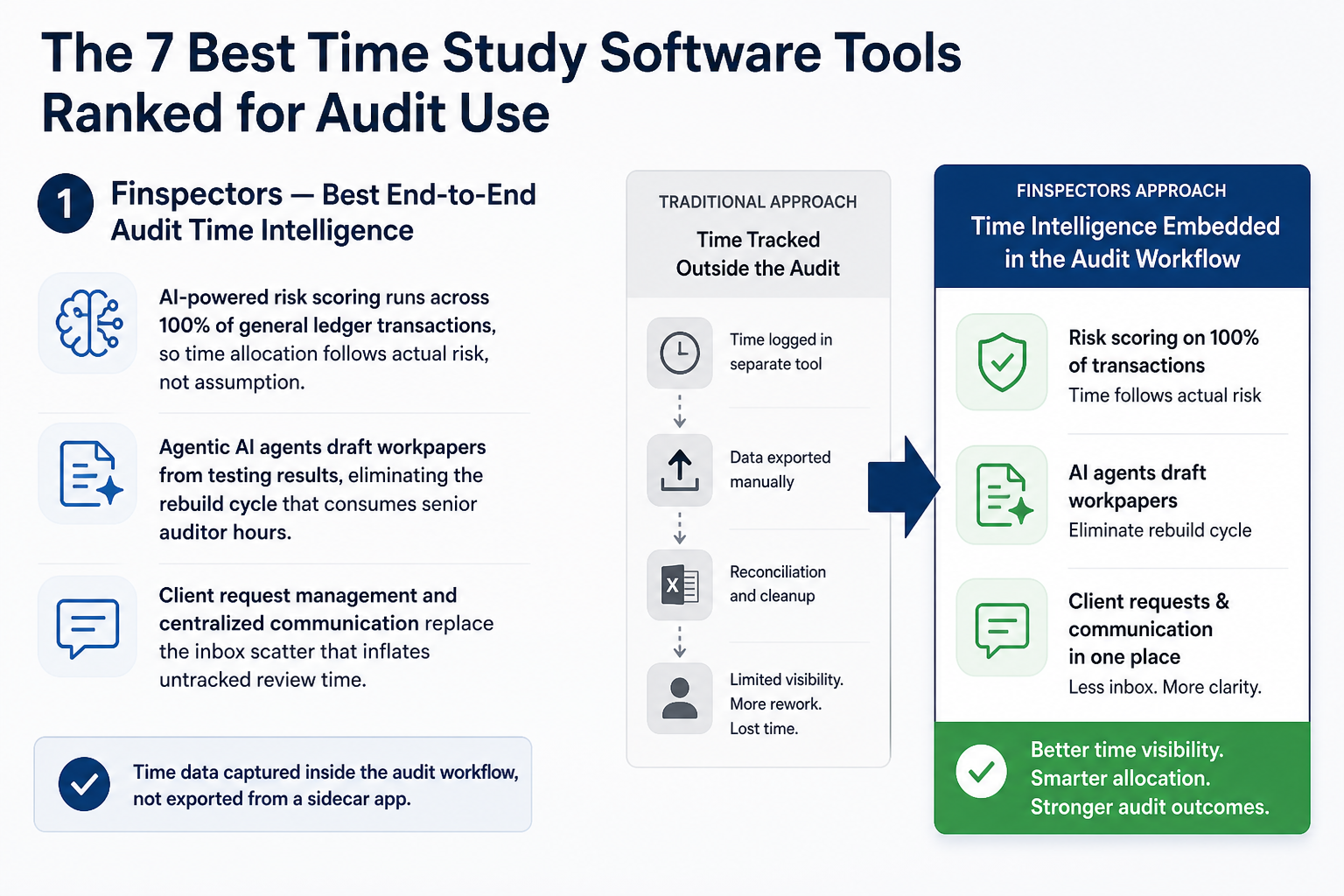
1. Finspectors — Best End-to-End Audit Time Intelligence
Verdict: The only tool on this list where time intelligence is embedded inside the audit workflow rather than bolted on.
Key audit features:
- AI-powered risk scoring runs across 100% of general ledger transactions, so time allocation follows actual risk, not assumption
- Agentic AI agents draft workpapers from testing results, eliminating the rebuild cycle that consumes senior auditor hours
- Client request management and centralized communication replace the inbox scatter that inflates untracked review time
Limitation: Finspectors is purpose-built for financial audit. Teams looking for a generic billing tracker or non-audit time studies will not need its depth.
Best fit: Audit firms and internal audit groups that want time data captured inside the audit workflow, not exported from a separate app. Unlike every other tool on this list, Finspectors is the only platform purpose-built by chartered accountants to score 100% of transactions with native ML risk scoring and run agentic AI agents across the full audit lifecycle, meaning time data is captured inside the workflow, not exported from a sidecar app.
2. Harvest — Best for Billing Reconciliation on Small Audit Teams
Verdict: A clean, reliable time and billing tool that audit teams can configure without IT support.
Key audit features:
- Budget alerts trigger when an engagement phase approaches its hour cap, giving managers early warning rather than post-mortem data
- Invoice generation connects directly to logged hours, reducing billing reconciliation time on flat-fee engagements
- QuickBooks and Xero integration keeps financial data in sync without manual exports
Limitation: Harvest has no audit-specific reporting. Engagement phase breakdowns require manual project structure setup, which takes discipline to maintain across a team.
Best fit: Small CPA firms and solo practitioners running straightforward assurance or review engagements who need a billing-connected time tracker without complexity.
3. Toggl Track — Best Lightweight Option for Solo Practitioners
Verdict: Fast to start, easy to use, and sufficient for practitioners tracking billable hours across a handful of clients.
Key audit features:
- One-click timers with browser and desktop integrations minimize the gap between starting work and logging time
- Tag-based organization lets solo practitioners segment hours by engagement area without building a full project hierarchy
- Detailed reports export cleanly to CSV for inclusion in engagement files
Limitation: Toggl Track has no WIP reporting, no billing integration for audit firms, and no review-cycle visibility. It records time but does not analyze it.
Best fit: Solo practitioners or two-person audit teams who need a frictionless time log rather than an engagement analytics platform.
4. Clockify — Best Free Tier for Budget-Constrained Audit Departments
Verdict: The most capable free time tracking option available, with enough structure for small audit teams.
Key audit features:
- Unlimited users and projects on the free tier, which matters for internal audit departments with headcount constraints
- Project and task hierarchy supports basic engagement phase structure
- Attendance tracking and timesheet approval workflows add a light layer of manager oversight
Limitation: Advanced reporting, QuickBooks integration, and budget tracking are locked behind paid tiers. The free version surfaces hours but not profitability.
Best fit: Internal audit teams or nonprofit audit functions operating under tight software budgets who need more structure than a spreadsheet.
5. TimeSolv — Best for Law-Firm-Adjacent Audit and Advisory Practices
Verdict: Built for professional services billing, with billing code structures that translate well to audit and advisory work.
Key audit features:
- Matter-based billing structure mirrors the engagement structure used by audit and advisory practices running parallel to legal clients
- LEDES billing format support reduces friction for firms serving law-firm clients or running joint advisory mandates
- Detailed WIP reports and trust accounting features support multi-phase engagement management
Limitation: TimeSolv's audit-specific reporting is limited. It is a billing-first tool, not an audit workflow tool, and requires manual mapping of audit phases to billing codes.
Best fit: Accounting and advisory firms with law-firm clients or practices that need professional services billing discipline alongside basic time study capability.
6. BigTime — Best for Mid-Market Audit Firms Needing WIP Reporting
Verdict: A professional services platform with WIP reporting, utilization dashboards, and QuickBooks sync that mid-market audit firms can actually use out of the box.
Key audit features:
- Built-in WIP reporting shows unbilled hours by staff, engagement, and phase without manual spreadsheet work
- Staff utilization dashboards give audit managers visibility into capacity before engagements are scheduled, not after they are already overloaded
- QuickBooks integration and ERP connectors reduce the billing reconciliation burden on practice managers
Limitation: BigTime's setup complexity is higher than Harvest or Toggl. Non-technical staff need a structured onboarding period, and configuration mistakes in the project hierarchy are hard to undo.
Best fit: Audit firms with 15 to 100 staff who need WIP reporting and utilization analytics built into the same platform as their time tracking.
7. Replicon — Best for Enterprise Audit Groups With Compliance Requirements
Verdict: A workforce time management platform with compliance-grade controls that enterprise audit groups and Big-Four-adjacent firms need for internal governance.
Key audit features:
- Policy-driven time capture enforces submission and approval deadlines, which matters for audit groups with internal SLA commitments
- Integration with SAP, Oracle, and major ERP systems connects time data to financial reporting workflows
- Configurable compliance controls support internal audit quality management requirements
Limitation: Replicon is priced and structured for enterprise deployment. Small or mid-market firms will find the configuration overhead disproportionate to their needs.
Best fit: Enterprise internal audit departments and large public accounting firms that need compliance-grade timekeeping integrated with existing ERP infrastructure.
Time Study Software Comparison: Which Tool Fits Your Audit Team Size
Solo Practitioners and Small CPA Firms (1–10 Staff)
Small teams need low friction above everything else. A tool that takes three minutes to configure per engagement and zero IT support wins over a feature-heavy platform that nobody uses consistently.
Best choices: Toggl Track for pure simplicity. Harvest when billing reconciliation matters. Clockify when budget is the binding constraint.
Mid-Market Audit Firms (11–100 Staff)
Mid-market firms need WIP reporting, staff utilization visibility, and at least a basic integration with QuickBooks or their general ledger. Generic time trackers break down here because partner review requires more than a CSV export.
Best choices: BigTime for WIP and utilization reporting. Finspectors when the firm wants time intelligence embedded inside the audit workflow rather than managed separately.
Enterprise and Big-Four-Adjacent Audit Groups (100+ Staff)
Enterprise audit groups need compliance-grade controls, ERP integration, and policy enforcement across large teams operating across multiple geographies or service lines.
Best choices: Replicon for compliance-grade enterprise deployment. Finspectors for audit-specific workflow intelligence at scale.
Comparison table:
| Tool | Best For | Free Tier | QuickBooks/ERP Integration | Audit-Specific Reporting |
|---|---|---|---|---|
| Finspectors | End-to-end audit workflow intelligence | No | Yes (ERP-connected) | Yes, purpose-built |
| Harvest | Small team billing reconciliation | Limited | Yes (QuickBooks, Xero) | No |
| Toggl Track | Solo practitioners | Yes | Limited | No |
| Clockify | Budget-constrained teams | Yes | Paid tier only | No |
| TimeSolv | Advisory/law-adjacent firms | No | Yes | Limited |
| BigTime | Mid-market WIP reporting | No | Yes (QuickBooks, ERP) | Partial |
| Replicon | Enterprise compliance | No | Yes (SAP, Oracle) | Partial |
How to Implement Time Study Software Without Killing Audit Momentum
Most time study software failures are not selection failures. They are implementation failures. The tool gets purchased, configured once, and quietly abandoned after the first busy season.
Map Your Engagement Phases Before Configuring Any Tool
Before touching the software, list every phase your audit engagements actually run through: client onboarding, risk assessment, planning, interim fieldwork, year-end fieldwork, review cycles, and wrap-up. Map these phases in the tool's project hierarchy before staff log a single hour. Teams that skip this step end up with time data that cannot be compared across engagements because everyone labeled phases differently.
This mapping step also forces a useful conversation: which phases consistently run over budget, and which are under-scoped in fee estimates? The answer shapes how you weight the reporting setup.
The Documentation Handoff Problem and How to Solve It
One of the most common reasons time study tools fail in audit is the documentation handoff gap. An engagement completes, the time data is captured, but nobody updates the workpaper templates or engagement letter scope assumptions before the next similar engagement starts. The plant slides back to old habits, to borrow language from manufacturing. In audit terms, the firm reprices the next engagement using last year's assumptions instead of last engagement's data.
Tools that shorten the gap between completed time study data and updated standard work retain adoption better than feature-heavy alternatives. For audit teams, this means configuring the tool so that engagement close triggers a structured review of phase budgets versus actuals, with a direct link to workpaper template updates and engagement letter scope notes. Workflow software for accountants that connects time data to document outputs reduces this gap from weeks to days.
Getting Senior Auditor Buy-In in the First Two Weeks
Senior auditors are the adoption bottleneck. If they do not log time consistently in the first two weeks, the data set is poisoned and managers lose confidence in the reports. The fastest path to buy-in is showing senior auditors one concrete output that helps them, not just the firm: a phase-level budget-versus-actual view they can use to push back on scope creep in real time.
Run one engagement as a pilot with a senior auditor who already logs time discipline in other tools. Their setup becomes the template. Their report becomes the demonstration to the rest of the team.