



Auditing Government: Key Risks, Standards, and Red Flags
A government audit finding triggered by a disclosure omission is one of the most avoidable outcomes in public-sector practice. The team tested the right transactions, documented the right controls, and still produced a reportable finding because a material audit adjustment was categorized as non-grant-related and never surfaced in the single audit documentation. The assumption that GAGAS only required disclosure for grant-linked items was wrong, and the finding proved it.
That assumption gap is where most government audit failures originate. Auditing government entities looks like standard financial auditing on the surface. Underneath, it carries a distinct compliance structure, program-specific risk layers, and documentation obligations that differ sharply from commercial engagements. Experienced teams get caught because they apply a commercial risk lens to a government context.
This article gives you a decision-ready framework covering the key risks, applicable standards, and the specific red flags that separate a clean government audit opinion from a preventable finding.
Why Auditing Government Entities Demands a Different Risk Lens
Government audits are not stricter versions of commercial audits. They are structurally different. The objective shifts from expressing an opinion on financial statements alone to also assessing compliance with federal program requirements, evaluating internal controls over compliance, and meeting accountability obligations to legislators and the public.
Public Accountability vs. Financial Statement Focus
In a commercial audit, the primary accountability is to shareholders and creditors. In a government or nonprofit single audit, accountability extends to federal agencies, oversight bodies, and the public. This changes what must be reported and what triggers a finding. Material weaknesses that have no connection to grant funding still require disclosure under GAGAS. Treating a government engagement like a company audit based on financial materiality alone will produce gaps.
How Federal Program Compliance Layers onto GAAS Requirements
GAAS governs the financial statement opinion. GAGAS and the OMB Compliance Supplement govern the compliance layer on top. The audit plan must address both. The process of an audit in a government context includes testing compliance with specific requirements for each major federal program: allowable costs, cash management, procurement, reporting, and subrecipient monitoring. These are not optional extensions. They are required audit process steps that generate separate findings if deficient.
The Difference Between Internal and External Auditors in a Government Context
The distinction matters for scoping and for understanding who is responsible for what. The table below captures the key differences.
| Dimension | Internal Auditor | External Auditor |
|---|---|---|
| Scope | Operational effectiveness, risk management, internal controls | Financial statements, federal program compliance, GAGAS |
| Reporting line | Reports to management or audit committee | Reports to oversight body, funding agencies, and the public |
| Accountability | Serves the organization | Serves the public and regulatory stakeholders |
| Findings authority | Advisory; recommendations to management | Binding; findings appear in public audit reports |
| Independence standard | Functionally independent | Legally and organizationally independent |
The difference between internal and external auditors is not just structural. External auditors in government engagements carry public accountability that changes the weight of every documented judgment.
GAGAS and the OMB Compliance Supplement: The Standards Government Auditors Work Under
Two frameworks govern every government engagement. Understanding what each one requires is a prerequisite for building a compliant audit plan.
What GAGAS Requires Beyond Standard GAAS
Generally Accepted Government Auditing Standards extend GAAS requirements in several areas. GAGAS mandates disclosure of all material weaknesses and significant deficiencies, regardless of whether they relate to grant funding. It requires auditors to document their independence assessment, apply continuing professional education standards specific to government audit, and follow additional fieldwork and reporting standards not present in GAAS alone.
The most common misunderstanding: teams assume GAGAS disclosure only applies when findings are grant-related. The standard is broader. Any material audit adjustment, any significant deficiency in internal controls, and any instance of fraud, illegal acts, or noncompliance must be disclosed whether or not it touches federal funds.
How the OMB Compliance Supplement Defines Major Program Audit Scope
The OMB Compliance Supplement identifies which compliance requirements are subject to audit for each major federal program. These requirements include allowable costs, cash management, procurement, reporting, and subrecipient monitoring. For each area, auditors must design audit substantive tests and control testing procedures that directly address the requirement. The Supplement is not background reading. It is the specification for what the engagement must cover and test.
Analytical review of program expenditures against the Supplement's requirements is a minimum starting point for planning. Walkthrough templates and test of controls audit procedures should be aligned to Supplement categories, not built generically.
Expected 2026 Compliance Supplement Updates and What They Mean for Audit Planning
As of late July 2026, the final 2026 OMB Compliance Supplement had not yet been issued. Audit teams should monitor for its release and assess how changes affect engagement planning immediately upon publication.
Based on expected updates, several programs are anticipated to receive higher-risk designations. The Medicaid Cluster, the Child Care and Development Fund Cluster, and Temporary Assistance for Needy Families are all expected to be identified as higher-risk programs. This directly affects major program determination and the level of compliance testing required. The Abandoned Mine program is expected to lose its higher-risk designation, which may reduce the scope of testing required for recipients of those funds.
These designations shape which programs receive the most intensive audit attention. Audit plans built before the final Supplement is released should include a checkpoint to incorporate any confirmed changes to higher-risk program lists before fieldwork begins.
Auditing Government Programs: The Seven Red Flags That Produce Findings
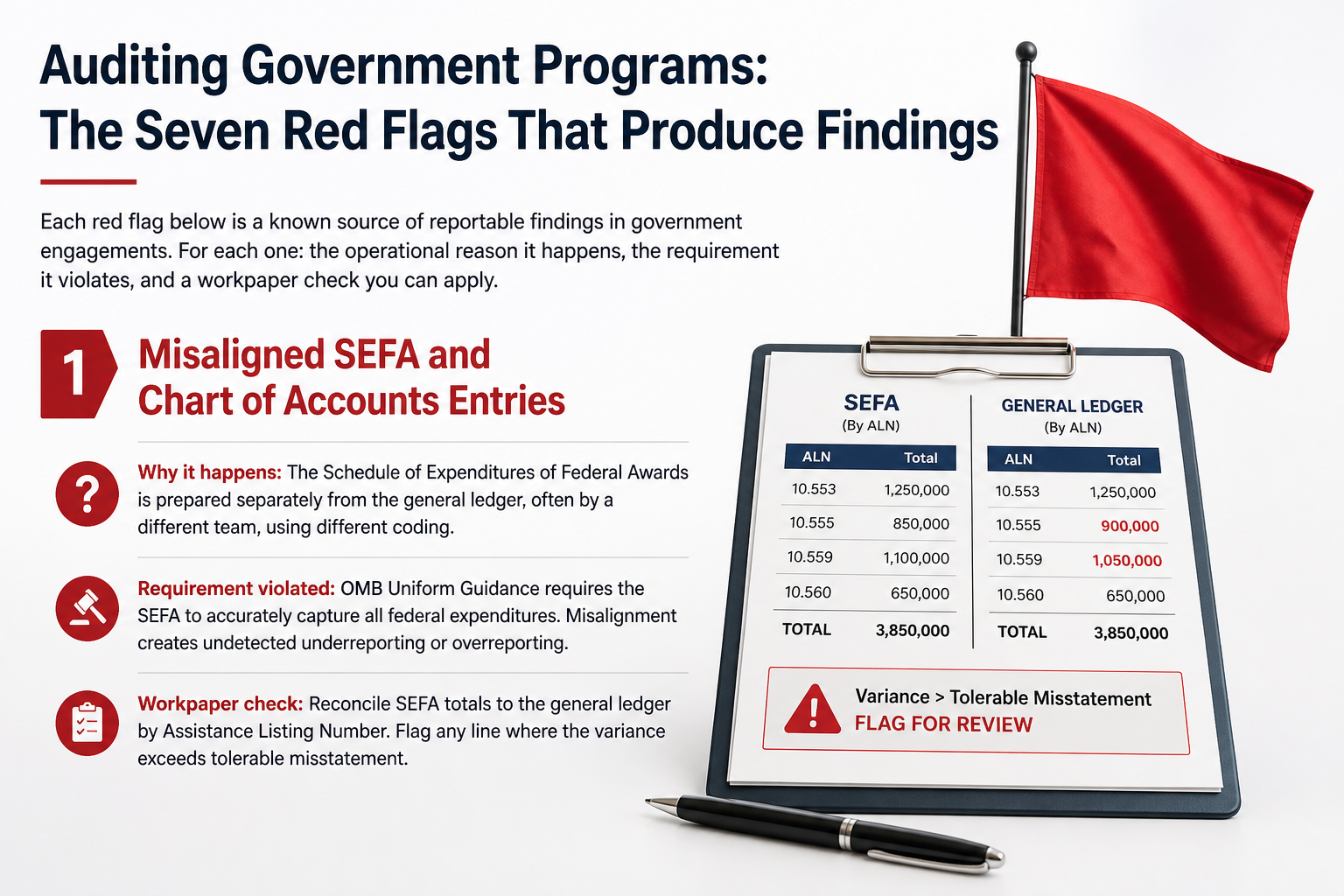
Each red flag below is a known source of reportable findings in government engagements. For each one: the operational reason it happens, the requirement it violates, and a workpaper check you can apply.
1. Misaligned SEFA and Chart of Accounts Entries
Why it happens: The Schedule of Expenditures of Federal Awards is prepared separately from the general ledger, often by a different team, using different coding. Requirement violated: OMB Uniform Guidance requires the SEFA to accurately capture all federal expenditures. Misalignment creates undetected underreporting or overreporting. Workpaper check: Reconcile SEFA totals to the general ledger by Assistance Listing Number. Flag any line where the variance exceeds tolerable misstatement.
2. Grant Funding Recorded in the Wrong Accounting Period
Why it happens: Grant revenue recognition is driven by when conditions are met, not when cash is received. Teams sometimes book receipts on a cash basis. Requirement violated: GAAP and Uniform Guidance require period-specific recognition tied to expenditure of funds and satisfaction of conditions. Workpaper check: Test a sample of grant receipts against the period of qualifying expenditure. Confirm no revenue recorded before conditions were met.
3. Undisclosed Material Audit Adjustments Under GAGAS
Why it happens: Audit adjustments unrelated to grants are categorized internally as financial-statement-only matters and excluded from single audit documentation. Requirement violated: GAGAS requires disclosure of all material audit adjustments regardless of their relationship to federal programs. Workpaper check: Pull all top-side and proposed adjustments from the engagement. Confirm each one was evaluated for GAGAS disclosure, not just GAAP materiality.
Manual workpaper review makes it easy for disclosure gaps like these to slip through, especially when adjustments are never tagged for single audit consideration. Finspectors' agentic AI runs across 100% of transactions using native ML risk scoring, automatically flagging adjustment entries that meet GAGAS disclosure thresholds regardless of their grant association. This removes the assumption gap before it becomes a finding.
4. Subrecipient Monitoring Gaps in Pass-Through Awards
Why it happens: Pass-through entities focus on their own compliance and treat subrecipient oversight as an administrative function rather than an audit requirement. Requirement violated: OMB Uniform Guidance requires pass-through entities to monitor subrecipient compliance with federal program requirements. Workpaper check: Confirm the client has documented subrecipient risk assessments, monitoring procedures, and follow-up actions for each active pass-through award.
5. Procurement and Allowable Cost Exceptions in Major Programs
Why it happens: Procurement policies are written for operational purposes. Staff making purchasing decisions often have no visibility into federal cost principles. Requirement violated: OMB Compliance Supplement procurement requirements and 2 CFR Part 200 allowable cost rules. Workpaper check: Sample procurement transactions in major programs. Verify competitive bidding documentation and confirm each cost maps to allowable cost categories.
6. Incomplete Cash Management Documentation
Why it happens: Grant drawdowns are managed in treasury, not by the program compliance team. The two functions rarely sync on documentation. Requirement violated: OMB Compliance Supplement cash management requirements prohibit excess cash on hand and require timely drawdown. Workpaper check: Compare drawdown dates to expenditure dates for sampled transactions. Flag patterns of early drawdown or excess cash held longer than allowed.
7. Missing or Inadequate Follow-Up on Prior-Year Findings
Why it happens: Management prepares corrective action plans but does not assign clear ownership or completion dates. Auditors in subsequent years assume resolution without testing. Requirement violated: GAGAS requires auditors to follow up on prior findings. Unresolved findings that recur become repeat findings, which carry greater scrutiny. Workpaper check: Obtain the prior-year audit report and corrective action plan. For each prior finding, document the current-year test results confirming resolution or continued noncompliance.
Building a Risk-Based Audit Plan for Government Engagements
A government audit plan that mirrors a commercial engagement structure will miss required procedures. The planning phase must account for program risk, stakeholder obligations, and the limitations of instinct-based risk assessment.
Prioritizing Higher-Risk Program Designations in Major Program Determination
Start with the Type A/B program threshold calculation under Uniform Guidance, then layer in current higher-risk designations from the OMB Compliance Supplement. Programs already carrying a higher-risk designation, such as the Medicaid Cluster and Child Care and Development Fund Cluster for 2026, should move to the top of your major program selection. Allocate audit hours proportionally to program risk, not to dollar thresholds alone.
Stakeholder Engagement Requirements Unique to Government Audits
Government audits require active engagement with legislators, oversight bodies, and the public. This is not a soft best practice. It affects what questions auditors ask, what risks they elevate, and how findings are framed in the report. Document stakeholder input during planning. Establish communication protocols that allow findings to be presented in a clear and actionable way to non-technical audiences. Collaborative relationships with auditees also improve the implementation rate of audit recommendations, which affects follow-up findings in subsequent years.
Using Analytics and Technology to Replace Instinct-Based Risk Scoring
Professional guidance for government auditors is direct: leverage advanced data analytics and other technologies to enhance audit efficiency and effectiveness, and stay informed about emerging technologies such as artificial intelligence and their potential applications in auditing. In practice, this means replacing manual risk assessment judgments with transaction-level data analysis.
For a field audit of a large federal program, testing a sample of transactions and inferring population risk is no longer sufficient when full-population testing is achievable. Analytics applied to the complete general ledger will surface anomalies that sample-based auditing misses. Remote audits benefit especially, since data-driven evidence review reduces dependence on physical document access. Building analytics into the audit plan from the start, rather than treating them as a supplemental step, changes the quality of the risk assessment entirely.
Auditing Government Entities With the Right Tools: What Your Tech Stack Must Support
Government audit complexity puts pressure on tools that work adequately for commercial engagements. The documentation burden, evidence reconciliation requirements, and quality management obligations are materially heavier.
Why Spreadsheet-Based Evidence Testing Fails at Government Audit Scale
Spreadsheets break down when tick and tying across hundreds of grant transactions, reconciling SEFA to the general ledger, and managing information produced by the entity (IPE) for multiple programs simultaneously. Manual evidence reconciliation introduces error risk at exactly the points where government audit documentation must be defensible. When audit findings are reviewed by federal agencies, a workpaper trail built on disconnected Excel files does not hold up under scrutiny.
Must-Have Capabilities: Automated Workpaper Generation, Workflow Management, and Quality Review
Any accounting and auditing software used for government engagements must support automated workpaper generation directly from testing results, not just document storage. Workflow management software for accounting firms must include task-level sign-off tracking and review status visibility across the engagement. Quality management integration tied to ISQM or SQMS standards must be built in, not bolted on as an add-on. These are not premium features for large firms. They are operational requirements for government audit compliance.
How Private Versus Government Audits Differ in Documentation Burden
Private audits carry financial statement documentation requirements. Government audits carry all of that plus program-specific compliance testing documentation, SEFA reconciliation workpapers, subrecipient monitoring records, and GAGAS independence and CPE documentation. The best software for accounting firms handling government engagements must support both layers without requiring teams to maintain parallel workpaper systems. Firms that retrofit general-purpose accounting software for government audit create unnecessary risk through documentation gaps the software was never designed to prevent.
Conclusion
You now have enough information to make a specific decision. Given the GAGAS disclosure requirements, the expected higher-risk program designations for 2026, and the documentation demands of a compliant single audit, the question is whether your current audit plan and toolset were built for government complexity or adapted from commercial engagements.
Teams that treat government audits as standard engagements with extra steps keep generating preventable findings. Teams that rebuild their planning, evidence testing, and workpaper processes around the red flags and standards covered here produce cleaner opinions with less rework and fewer repeat findings.
See how Finspectors automates risk scoring and workpaper generation for government engagements. Request a walkthrough built around your specific audit program.