



What a Field Audit Actually Is — and When It Applies
A field audit is an examination conducted on-site at the auditee's premises. The audit team reviews records, interviews personnel, and tests controls directly in the environment where transactions originate. That on-site access is what separates a field audit from less intensive review types.
Field Audit vs. Office and Correspondence Audits
A correspondence audit happens entirely by mail or secure portal. The auditee submits documents to support specific line items, and the auditor reviews them remotely. An office audit brings the auditee to the auditor's location to review a limited scope of records. A field audit reverses that dynamic. The auditors go to the auditee, which allows broader access to systems, personnel, and source documentation. The scope is wider, the evidence more complex, and the execution risk higher.
When Regulators and Internal Teams Use Field Audits
Regulators trigger field audits when the expected yield from a thorough on-site examination justifies the resource investment. Field audits are becoming fewer in number but more targeted, focusing specifically on the highest-risk, highest-yield issues. That shift matters for audit managers: when a field audit does happen, the scrutiny is intense and the preparation window is shorter. Execution quality is no longer a differentiator. It is the baseline expectation.
Internal audit teams use field audits when remote testing cannot give sufficient assurance. Complex operations, manual control environments, and high-risk processes all warrant on-site examination.
What Distinguishes a Field Audit from a Company Audit or Private Audit
A company audit covers the full financial statements of an entity and follows statutory requirements. A private audit is typically commissioned by an owner or stakeholder outside a regulatory mandate. A field audit is defined by its methodology and location, not its trigger. A field audit can be part of a company audit, a regulatory examination, or an internal assurance program. The process of an audit does not change based on who commissioned it. The sequencing, evidence standards, and reporting requirements apply regardless.
The Field Audit Process: Six Stages From Planning to Report
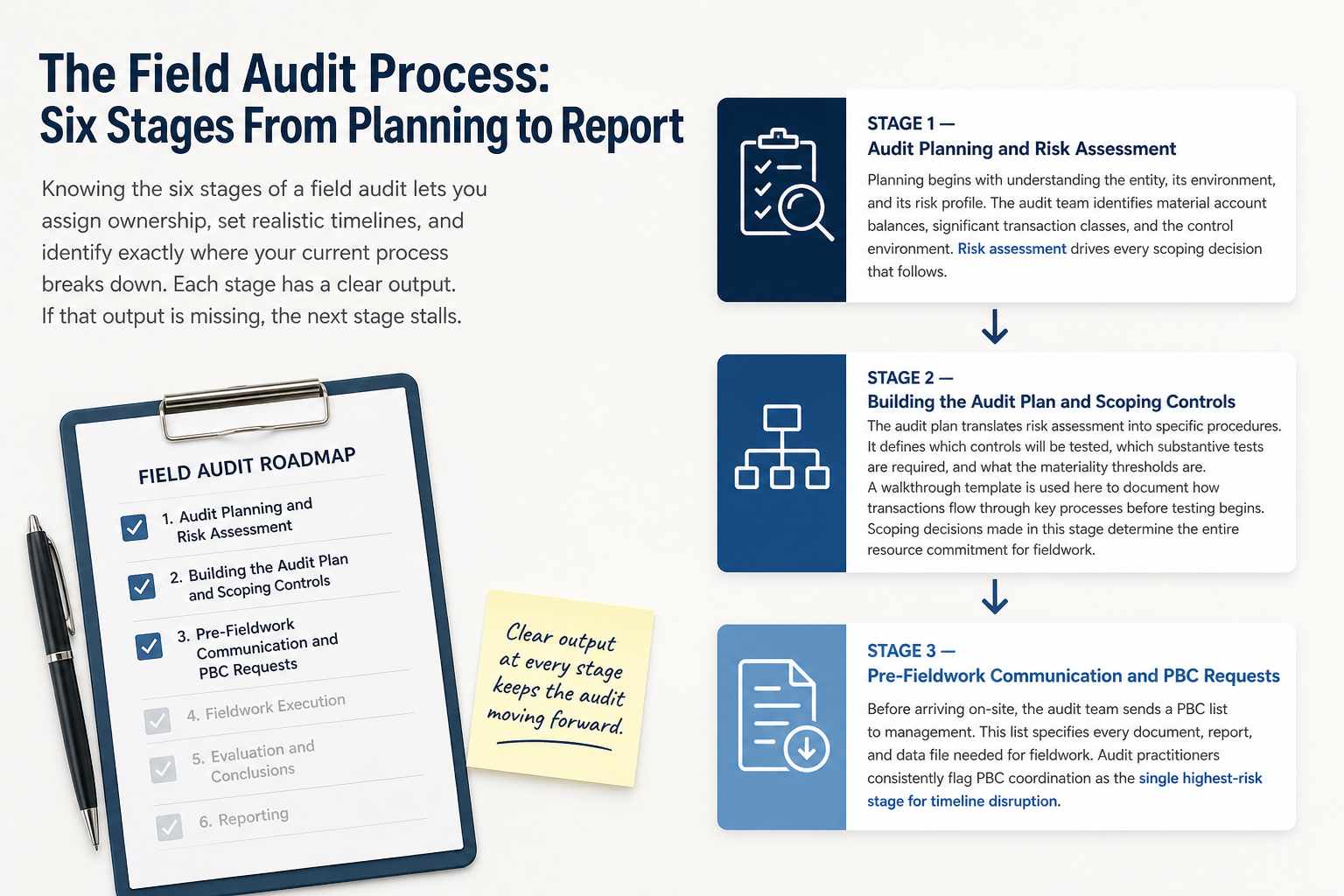
Knowing the six stages of a field audit lets you assign ownership, set realistic timelines, and identify exactly where your current process breaks down. Each stage has a clear output. If that output is missing, the next stage stalls.
Stage 1 — Audit Planning and Risk Assessment
Planning begins with understanding the entity, its environment, and its risk profile. The audit team identifies material account balances, significant transaction classes, and the control environment. Risk assessment drives every scoping decision that follows. Without a structured risk assessment, fieldwork covers too much low-risk ground and not enough high-risk territory.
Stage 2 — Building the Audit Plan and Scoping Controls
The audit plan translates risk assessment into specific procedures. It defines which controls will be tested, which substantive tests are required, and what the materiality thresholds are. A walkthrough template is used here to document how transactions flow through key processes before testing begins. Scoping decisions made in this stage determine the entire resource commitment for fieldwork.
Stage 3 — Pre-Fieldwork Communication and PBC Requests
Before arriving on-site, the audit team sends a PBC list to management. This list specifies every document, report, and data file needed for fieldwork. Audit practitioners consistently flag PBC coordination as the single highest-risk stage for timeline disruption. Communicating with key stakeholders before fieldwork starts is best practice. It aligns expectations, surfaces access issues early, and prevents the most common cause of engagement delays.
Stage 4 — Fieldwork: Test of Controls and Substantive Testing
Fieldwork is where the audit plan gets executed. Control testing audit procedures verify whether controls operate as designed. Audit substantive tests confirm that account balances and transaction totals are free from material misstatement. Tick and tying, the process of tracing figures across documents to confirm consistency, happens throughout this stage. Each test result is documented in a workpaper as it is completed.
Stage 5 — Analytical Review and Evidence Reconciliation
Analytics in audit serves two purposes during fieldwork: it identifies anomalies the team needs to investigate, and it provides independent confirmation that substantive results are directionally consistent. Analytical review compares current-period figures against prior periods, budgets, and industry expectations. Evidence reconciliation confirms that every tested item is traceable back to source documentation. Any gap found here must be resolved before the file moves to review.
Stage 6 — Reporting, Opinion, and Sign-Off
The audit report delivers the team's conclusions to the intended audience. An unqualified opinion means financial statements are presented fairly in all material respects. A qualified opinion identifies specific areas where that conclusion cannot be reached. An adverse opinion means statements are materially misstated. A disclaimer of opinion means the auditor was unable to obtain sufficient evidence to form a conclusion. The report structure should include an executive summary, the audit objectives and scope, the methodology used, and clear findings tied to the risk areas that mattered to management. Sign-off requires a complete, reviewed file. Incomplete workpapers at this stage are the most common cause of delayed issuance.
Field Audit Checklist: What to Prepare Before, During, and After Fieldwork
Pre-Fieldwork Checklist: PBC List, Access, and Stakeholder Alignment
Late or incomplete PBC submissions are among the most frequently cited causes of audit timeline overruns. Audit lag carries a real cost: extended timelines increase uncertainty for stakeholders and raise the cost of equity capital. Start fieldwork with every item confirmed.
- Finalize and send the PBC list at least two weeks before fieldwork starts
- Confirm system access and user credentials for all auditors attending on-site
- Schedule walkthroughs with process owners for each significant control area
- Hold a pre-fieldwork meeting with key stakeholders to surface concerns and access constraints
- Confirm materiality thresholds and scoping decisions are signed off by the engagement partner
- Verify that prior-year workpapers are accessible and reviewed for carry-forward items
If your team is still assembling PBC requests manually and tracking evidence in shared folders, Finspectors replaces that workflow with an AI-native audit workspace that auto-generates workpapers, scores 100% of transactions for risk, and keeps every document traceable in one place. It is built by chartered accountants specifically for this stage of the engagement.
During Fieldwork: Evidence Testing and Workpaper Standards
- Document each test result in the workpaper immediately after testing, not at day-end
- Cross-reference every exception to the relevant control or assertion before moving on
- Confirm that IPE (information produced by the entity) is validated before it is relied upon as evidence
- Flag any scope expansions to the engagement manager the same day they are identified
- Maintain a daily open-items list and send it to the client contact each morning
- Ensure all third-party auditor deliverables are received and cross-referenced before the final fieldwork day
Post-Fieldwork: Review, Sign-Off, and Report Delivery
- Complete all workpaper cross-referencing before submitting the file for manager review
- Resolve every review note with documented support, not just a comment
- Confirm the draft report has been reviewed against the engagement risk assessment
- Issue the final report within the timeline committed at the planning stage
Five Field Audit Pitfalls That Derail Timelines — and How to Prevent Them
Pitfall 1 — Late or Incomplete PBC Submissions
In practice, this looks like a PBC list sent one week before fieldwork with no follow-up cadence, leaving the team to chase documents on-site. It happens because PBC requests are treated as administrative tasks rather than engagement-critical milestones. Prevention: build PBC submission deadlines into the engagement timeline with a client-facing tracker, and assign one team member as the daily follow-up owner.
Pitfall 2 — Insufficient Documentation of Internal Controls
Teams often document that a control exists without documenting that it operated effectively during the period. This creates a gap that reviewers flag late in the engagement. It happens because walkthrough documentation is deprioritized when fieldwork pressure builds. Prevention: complete and sign off all control walkthrough documentation before substantive testing begins, not after.
Pitfall 3 — Manual Evidence Matching That Misses Exceptions
Reconciling transaction samples in Excel across multiple worksheets creates version-control risk and human error. Exceptions that fall outside the sample are never tested. It happens because manual matching is the inherited workflow, not a deliberate choice. Prevention: define your sample selection methodology in the audit plan and document the full selection criteria in the workpaper before testing starts, so exceptions are identifiable from the beginning.
Pitfall 4 — Workpapers Rebuilt From Scratch Each Engagement
Teams rebuilding templates, risk matrices, and control documentation from scratch on every engagement lose days of productive time before fieldwork even starts. It happens because there is no centralized, version-controlled workpaper library. Prevention: at the close of each engagement, archive the final workpaper set with a clear naming convention so it can be rolled forward on the next engagement without reconstruction.
Pitfall 5 — Delayed Review and Sign-Off From Incomplete Files
A partner or manager review that uncovers missing cross-references, unsupported conclusions, or incomplete evidence files sends the engagement backward at the most expensive moment. It happens because workpapers are assembled under time pressure without a completion checklist. Prevention: use a file-completion checklist that every preparer signs off before submitting for review. The checklist takes fifteen minutes. Rework takes days.
Internal vs. External Field Auditors: Who Owns What During the Engagement
On co-sourced or hybrid engagements, unclear ownership at hand-off points is a reliable source of evidence gaps and duplicated work. The difference between internal and external auditors is not just organizational. It determines scope, reporting lines, and independence requirements.
Key Differences in Scope, Independence, and Reporting Lines
| Dimension | Internal Auditor | External Auditor |
|---|---|---|
| Scope | Operational, compliance, and financial risk | Financial statement assertions |
| Independence standard | Organizational independence within the entity | Full independence from the entity |
| Report audience | Management and audit committee | Shareholders, regulators, public |
| Engagement trigger | Board mandate or risk-based internal plan | Statutory requirement or third-party request |
Where Hand-Off Points Break Down in Field Audits
External auditors rely on internal audit work to reduce their own procedures, but only if they have evaluated the quality and objectivity of that work. When this evaluation is not documented, external auditors repeat testing that internal teams already completed. The gap appears most often in control testing: internal audit completes a walkthrough, but external auditors cannot rely on it because the documentation does not meet their evidence standards. Agreeing on workpaper format and evidence requirements before fieldwork starts eliminates most of this duplication.
Conclusion
You now have the six stages, the checklist, and the five failure modes. The question is whether your current process can execute this without absorbing the delays described above.
Teams that run field audits on spreadsheets and shared inboxes will keep hitting the same bottlenecks: late PBC items, workpapers rebuilt from scratch, exceptions missed in manual matching. Teams that instrument their field audit workflow with purpose-built tooling eliminate those friction points before fieldwork starts, not during it.
See how Finspectors automates field audit workpapers, risk scoring, and evidence testing. Request a demo built around your next engagement.