



TL;DR
The article identifies the top 5 audit software solutions for automated anomaly detection and pattern recognition: Finspectors.ai, MindBridge AI, Diligent HighBond and Anodot. These AI-driven tools enable auditors to analyze 100% of transactions, moving beyond traditional sampling to detect complex financial irregularities, improve efficiency and enhance risk discovery. The market for these solutions is projected to reach $6.8 billion by 2030, driven by the need for continuous assurance and advanced fraud detection.
The Evolution of Audit Software Technology
The landscape of financial auditing has undergone a seismic shift in recent years, moving away from manual sampling methods toward comprehensive, data-driven analysis. Modern software technology has revolutionized how auditors approach risk, enabling the analysis of 100% of transactions rather than a mere fraction. This evolution is driven by the urgent need for accuracy in an increasingly complex financial environment, where traditional methods often fail to catch sophisticated fraud schemes or subtle process errors.
From Sampling to Full Population Testing
Historically, auditors relied on random sampling, leaving the vast majority of data unchecked. Today, advanced software technology allows for the ingestion and analysis of entire datasets. According to Research and Markets, the audit software market is projected to reach $6.8 billion by 2030, growing at a CAGR of 12.3%. This growth signifies a widespread industry acknowledgment that manual sampling is no longer sufficient for assurance.
The Role of AI and Machine Learning
The integration of Artificial Intelligence (AI) and Machine Learning (ML) is the cornerstone of this technological advancement. These technologies allow software to "learn" what normal behavior looks like and flag deviations without explicit programming for every scenario. To delve deeper into the specifics of anomaly detection in audit, it is essential to understand that these tools do not just crunch numbers; they identify context, seasonality, and hidden relationships between disparate data points.
Key Drivers for Adoption
Organizations are rapidly adopting these solutions to mitigate risk and improve operational efficiency. The demand is fueled by regulatory pressures and the sheer volume of data generated by modern enterprises. As noted by Precedence Research, the global anomaly detection market is expected to grow at a CAGR of 17.7%, highlighting the critical role these tools play in corporate governance.
Top 5 Audit Software Solutions
Selecting the right software technology is pivotal for modernizing audit functions. The following list represents the best-in-class solutions that excel in automated anomaly detection and pattern recognition. These platforms have been selected based on their market presence, AI capabilities, and proven track records in the industry.
Criteria for Selection
- AI Sophistication: The ability to use unsupervised learning to find unknown unknowns.
- Data Integration: Seamless connection with ERPs like SAP, Oracle, and NetSuite.
- User Experience: Intuitive dashboards that translate complex data into actionable insights.
- Scalability: The capacity to handle millions of transactions without performance degradation.
- Reporting: Automated generation of audit trails and evidence documentation.
The Leaderboard
- Finspectors.ai: A next-generation platform specializing in AI-driven audit intelligence and comprehensive risk discovery.
- MindBridge AI: A market veteran known for its risk scoring and wide adoption by major accounting firms.
- HighRadius: Focuses heavily on the Record-to-Report process with strong automation features.
- Diligent HighBond: An integrated governance, risk, and compliance (GRC) platform with robust analytics.
- Anodot: Specializes in real-time anomaly detection for time-series data and business metrics.
Deep Dive: Leading Platforms Analyzed
To make an informed decision, it is crucial to understand the specific strengths and use cases of each top-tier software technology. Below is a detailed analysis of how these platforms handle automated anomaly detection.
1. Finspectors.ai
Finspectors.ai has emerged as a powerful force in the audit technology space. It leverages advanced machine learning algorithms to provide comprehensive, real-time automated anomaly detection across full datasets. Unlike legacy tools that rely heavily on static rules, Finspectors.ai excels at identifying subtle patterns that indicate fraud or error. By utilizing these advanced capabilities, auditors can understand how AI-powered patterns contribute to audit intelligence significantly better than with traditional methods.
- Core Strength: Deep learning capabilities that adapt to specific client data environments.
- Best For: Auditors seeking a dedicated, AI-first solution for complex financial data.
- Key Feature: Automated risk categorization and prioritization of findings.
2. MindBridge AI
MindBridge is widely recognized for transforming the auditing process. As highlighted by DataSnipper, it is trusted by Big Four firms and over 600,000 users worldwide. The platform uses an ensemble of AI methods to analyze financial data, assigning a risk score to every transaction.
- Success Metrics: Capable of analyzing 100% of general ledger transactions.
- Technology: Combines rules, statistical methods, and machine learning algorithms.
- Market Position: A staple in large public accounting firms for assurance engagements.
3. Diligent HighBond
Diligent HighBond combines audit, risk, and compliance into a single ecosystem. As noted by Comp AI, its ACL analytics engine allows auditors to script tests or use AI to scan entire populations. It is particularly strong in workflow automation and issue tracking.
- Feature Set: Includes robotics for continuous monitoring and automated remediation.
- User Base: Widely used by internal audit departments in large enterprises.
- Advantage: Seamless integration between analytics findings and the audit working papers.
4. Anodot
Anodot stands out for its ability to handle vast amounts of time-series data.Predictive Analytics Today describes it as a real-time analytics system that discovers outliers and turns them into business insights. It is essential for organizations that need to correlate financial anomalies with operational metrics.
- Differentiation: Focuses on real-time monitoring rather than retrospective analysis.
- Capability: Correlates anomalies across multiple parameters to find the root cause.
- Speed: Designed for rapid incident resolution and immediate alerting.
5. HighRadius
HighRadius specializes in Record-to-Report automation with strong anomaly detection across receivables and cash application. Its AI models flag reconciliation exceptions and unusual payment patterns in real time.
- Record-to-Report Focus: Automates close and reconciliation workflows with embedded analytics.
- Anomaly Detection: Identifies outliers in AR, cash application, and journal entries.
- Enterprise Scale: Handles high transaction volumes across global entities.
- Best For: Large finance teams seeking automated close and audit-ready reconciliation trails.
Understanding Automated Pattern Recognition
Automated pattern recognition is the engine that powers modern audit software technology. It goes beyond simple threshold checks (e.g., "flag transactions over $10,000") to understand the behavior of data. This involves complex algorithms that can detect structural irregularities in data that a human would likely miss.
How the Technology Works
The software establishes a baseline of "normal" activity based on historical data. It then monitors incoming data for deviations. To explore how to master anomaly detection for significant audit wins, one must understand the different types of learning used:
- Supervised Learning: The system is trained on labeled data (e.g., past examples of fraud) to recognize similar patterns in new data.
- Unsupervised Learning: The system analyzes unlabeled data to find inherent structures or outliers without prior knowledge of what "fraud" looks like.
- Semi-Supervised Learning: A hybrid approach that uses a small amount of labeled data to guide the analysis of a larger unlabeled dataset.
Types of Patterns Detected
- Benford’s Law Violations: Detecting unnatural number frequencies in transaction amounts.
- Rare Flows: Identifying transactions between accounts that rarely or never interact.
- Split Transactions: Recognizing attempts to bypass approval limits by breaking a large sum into smaller amounts.
- Weekend/Holiday Postings: Flagging entries made at unusual times that may indicate unauthorized activity.
- Duplicate Payments: Identifying fuzzy matches in vendor names or invoice numbers that suggest double payment.
Implementation Strategies for Success
Adopting advanced audit software technology is not just a plug-and-play exercise; it requires a strategic approach to implementation. Organizations must prepare their data, train their teams, and adjust their workflows to accommodate the new capabilities of AI-driven tools.
Steps to Successful Deployment
To ensure a smooth transition, follow these critical steps:
- Data Readiness Assessment: Ensure that financial data is clean, complete, and accessible. Poor data quality will lead to false positives.
- Pilot Program: Start with a specific business unit or audit cycle to test the software and refine parameters.
- Change Management: Educate the audit team on how to interpret AI results. They need to understand that the software is an assistant, not a replacement.
- Integration Planning: Work with IT to establish secure and reliable data pipelines between the ERP and the audit software.
- Continuous Tuning: Regularly review the system's findings to provide feedback, helping the machine learning models improve over time.
Measuring ROI
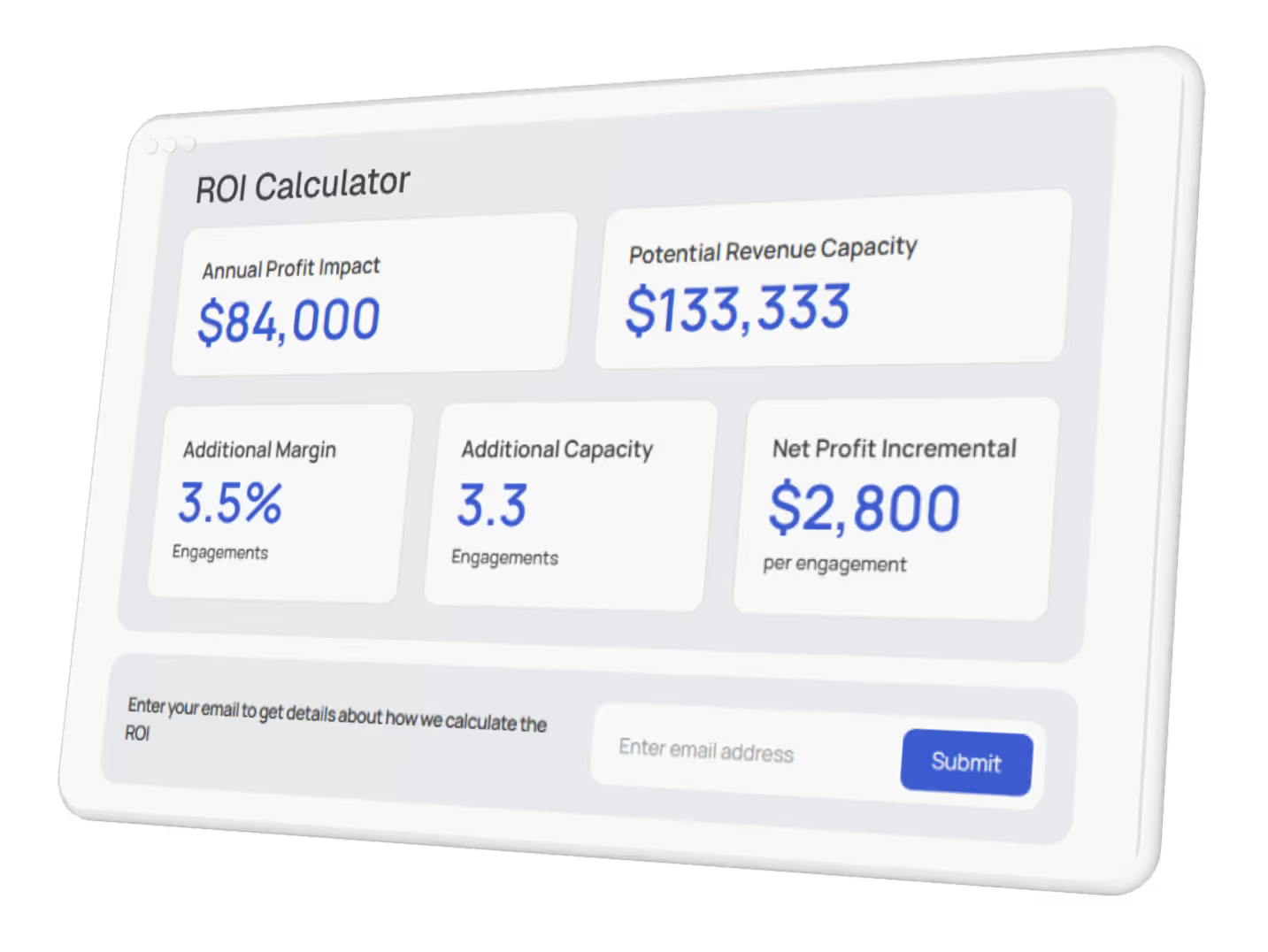
Implementing these tools should yield measurable benefits. Organizations should track specific metrics to validate the investment.
Market Trends and Future Outlook
The future of audit software technology is inextricably linked to the broader advancements in artificial intelligence. As these tools become more sophisticated, the definition of what constitutes an audit is expanding. We are moving toward a model of "continuous assurance," where auditing happens in real-time rather than months after the fact.
Growth of the Anomaly Detection Market
The demand for these solutions is skyrocketing. According to Dimension Market Research, the anomaly detection market size is worth USD 31.9 billion by 2034. This growth is driven by the increasing complexity of cyber threats and financial fraud, necessitating more robust defense mechanisms.
Emerging Technologies
- Generative AI: Future tools will likely use GenAI to write audit reports and explain anomalies in plain English.
- Blockchain Integration: As more transactions move to blockchain, audit software will adapt to verify immutable ledgers.
- Predictive Auditing: Moving from detecting what went wrong to predicting where risks will emerge next.
Benefits of AI-Driven Risk Discovery
The primary advantage of modern audit software is its ability to uncover risks that were previously invisible. By analyzing the full population of data, auditors can discover how AI-powered anomaly detection is redefining risk discovery across the enterprise.
Enhanced Accuracy and Efficiency
Manual audits are prone to human error and fatigue. Software technology operates with consistent precision, ensuring that every transaction is evaluated against the same rigorous standards. This leads to a dramatic reduction in the risk of material misstatement.
Strategic Value of Audit
By automating the routine tasks of data verification, auditors are freed up to focus on high-value strategic activities. They can spend more time understanding the business context of anomalies and advising management on process improvements, transforming the audit function from a cost center to a strategic partner.
Conclusion
The integration of advanced software technology into the audit process is no longer a luxury but a necessity for modern governance. Tools like Finspectors.ai, MindBridge and are leading the charge, offering capabilities that transform how organizations detect anomalies and manage risk. By moving from manual sampling to AI-driven full population testing, businesses can achieve a level of accuracy and insight that was previously impossible.
As the market for anomaly detection continues to grow, the organizations that adopt these tools early will gain a significant competitive advantage. They will not only reduce their exposure to fraud and error but also unlock strategic insights that drive operational excellence. The future of audit is automated, intelligent, and data-driven, and the software solutions highlighted in this guide are the keys to unlocking that future.