



TL;DR
AI auditing tools transform compliance by automating evidence collection, risk assessment, documentation, and continuous monitoring. Intelligent platforms reduce manual workload, improve accuracy, and support regulatory readiness without expanding team size.
Why AI Auditing Tools Matter for Compliance
The landscape for auditors and CPAs is increasingly complex, with regulatory requirements projected to grow significantly by 2026. This escalating scrutiny, coupled with the inherent bottlenecks of manual compliance processes, often leads to errors, delays, and auditor burnout. AI-powered audit tools are emerging as essential solutions to navigate this challenge, enabling firms to maintain robust compliance without the need to continuously expand their teams.
AI auditing tools are sophisticated software platforms that leverage artificial intelligence and machine learning to automate, streamline, and enhance various aspects of the audit process, particularly in compliance. These tools are designed to reduce the manual burden on audit teams while improving accuracy and ensuring adherence to rapidly evolving regulatory standards.
Understanding AI-Powered Compliance Automation
AI auditing tools are transforming compliance by automating tasks that traditionally consumed significant human effort. They provide continuous monitoring, automate evidence collection, and perform advanced risk assessments. Machine learning algorithms embedded within these tools can identify compliance gaps and potential violations proactively, often before they escalate into serious issues.
Intelligent audit workspaces differ significantly from traditional audit software. While traditional tools assist with data organization, intelligent platforms actively analyze data, learn from patterns, and flag anomalies. This shift allows auditors to move from reactive problem-solving to proactive risk management, enhancing overall audit quality and efficiency. For more insights on how this technology is reshaping the industry, explore how AI-powered auditing is revolutionizing business process controls.

5 Ways AI Auditing Tools Reduce Compliance Work
AI auditing tools introduce unprecedented efficiencies into the compliance workflow, significantly reducing manual effort and improving accuracy.
- Automated evidence gathering from multiple systems: AI tools eliminate the need for manual data collection by seamlessly integrating with various financial and operational systems. This capability can reduce manual evidence gathering hours by 85% and accelerate audit preparation times by 70% (Tracker Products).
- Real-time risk scoring flags high-priority issues: Machine learning identifies and prioritizes compliance risks instantaneously, allowing auditors to focus on critical areas without extensive manual review. This leads to significantly lower false positive rates in AML and other compliance checks (Sumsub).
- Intelligent documentation organizes audit trails automatically: AI systems automatically categorize and organize audit documentation, ensuring regulatory readiness and simplifying the review process. This automation helps maintain auditable records and ensures compliance with evolving standards like AS 1215 (PCAOB)).
- Continuous monitoring replaces periodic manual checks: Instead of episodic reviews, AI provides always-on compliance surveillance, detecting issues as they arise. Automated systems achieve 100% data coverage and daily monitoring, compared to manual biannual checks (Scytale.ai).
- Automated control monitoring: AI can continuously test controls, dramatically reducing the 70% of SOX compliance hours typically spent on administrative tasks like spreadsheet management (Zluri).
The adoption of audit management software can complete audits up to 70% faster (Smartaudits.online).
Manual vs AI-Powered Compliance Processes
This table compares traditional manual compliance workflows with AI-powered automation across key audit activities, demonstrating time savings and accuracy improvements that auditors can expect when adopting intelligent audit tools.
| Compliance Activity | Manual Process | AI-Powered Process | Time Savings | Accuracy Improvement |
|---|---|---|---|---|
| Evidence Collection | Weeks/months of data gathering from disparate systems | Automated, real-time collection from integrated platforms | 70-90% reduction (Tracker Products) | <5% error rate, 100% coverage (Tracker Products) |
| Risk Assessment | Subjective, periodic reviews based on samples | Continuous, data-driven identification of anomalies and risks | Significant, due to proactive flagging | 20-50% reduction in false positives (Sumsub) |
| Documentation Review | Tedious manual review of large document volumes | Intelligent analysis and summarization of relevant data | Up to 80% with IDP (Thunderbit) | Over 90% accuracy (Thunderbit) |
| Regulatory Monitoring | Manual tracking of regulatory changes and updates | Automated alerts and impact analysis of new regulations | From weeks to hours per cycle (CyberSaint) | Real-time, comprehensive coverage |
| Audit Trail Management | Manual logging and reconstruction of audit activities | Automated, immutable, and traceable record-keeping | Substantial, due to continuous logging | 100% traceable, verifiable records (RTS Labs) |
| Exception Identification | Human-dependent anomaly detection, prone to oversight | AI-driven pattern recognition and real-time anomaly alerts | Faster detection, reduced human effort | Higher accuracy, fewer missed findings (Scytale.ai) |
How Finspectors Streamlines Compliance Without Extra Effort
Finspectors offers an end-to-end intelligent audit workspace designed to automate and simplify compliance. Our platform is built for faster reviews, sharper insights, and seamless collaboration.
- Automates evidence collection across financial systems: Finspectors integrates directly with your existing ERPs and accounting software, pulling necessary data for continuous audit readiness. This eliminates the manual "evidence hunting" that consumes 20-40 hours per assessment (CyberSaint).
- Built-in risk scoring engine: Our platform prioritizes compliance issues by severity and likelihood, ensuring that your team focuses on the most critical risks. Machine learning models continuously refine their accuracy, reducing false positives and improving detection (Sumsub).
- Seamless collaboration features: Finspectors ensures audit teams are aligned on compliance requirements, facilitating communication and workflow management.
- Reduces review time while improving compliance accuracy: By automating routine tasks and providing real-time insights, Finspectors helps audit teams reallocate their time to higher-value judgment and advisory work. This directly addresses the 70% of SOX compliance hours spent on administrative tasks (Zluri).
Our solution ensures that automation technology improves audit compliance, allowing audit teams to focus on judgment, not grunt work.
Real-World Impact: Time and Cost Savings
The move to AI-powered auditing tools yields quantifiable benefits in both time and cost. Companies using AI-driven compliance systems could save as much as $183 billion annually (Thomson Reuters).
- Quantifiable reductions in compliance preparation time: Automated evidence collection alone can cut audit prep time by 50% (RTS Labs). Overall, AI tools can lead to 20-40% productivity gains and save large enterprises up to $3.7 million annually (AuditBoard).
- Reallocation of saved hours: With AI handling repetitive tasks, audit teams can shift their focus to strategic analysis, complex problem-solving, and offering higher-value advisory services. This aligns with the Big Four's vision of end-to-end AI automation by 2026, allowing auditors to make smarter scoping decisions (Accounting Today).
- Cost comparison: Investing in AI tools is significantly more cost-effective than hiring additional compliance staff. The average cost of compliance per incident for compliant organizations is $5.47 million, compared to $14.82 million for non-compliant ones (Talli.ai). AI tools help avoid these substantial penalties, offering an average 156% ROI in financial services (RTS Labs).
For firms concerned about SOX, AI can streamline processes significantly, leading to automation streamlines your controls without stress.
Implementing AI Auditing Tools: What to Expect
Implementing AI auditing tools involves a structured approach to ensure seamless integration and maximum benefit. For mid-size firms, initial pilots typically take 3-4 months, with full scaling spanning 6-18 months (Space-O AI).
- Typical implementation timeline: This usually includes 4-6 weeks for assessment, followed by 10-12 weeks for implementation and testing (Space-O AI). Integration with existing audit workflows, particularly with ERP systems, is a key focus. By 2026, 70% of organizations will shift to composable ERP, facilitating modular AI integrations (Volt Technologies).
- Training requirements for audit teams: While platforms like Finspectors are intuitive, some training will be required to maximize AI tool utilization. This addresses the challenge where only 47% of CFOs believe their teams are equipped to use AI, despite 78% investing in it (FloQast).
- Measuring ROI and compliance improvement: Firms can expect to see significant ROI within the first 90 days by tracking metrics like reduced audit preparation time, decreased error rates, and improved audit throughput. Google Cloud research indicates that enterprises tracking comprehensive operational metrics achieve 34% efficiency gains within 18 months (CloudGeometry).
Understanding regulatory compliance for smart audit automation is crucial for a successful transition. For more information, see automation technology improves audit compliance.
Key Takeaways
- Regulatory complexity is increasing; manual compliance processes are unsustainable for audit firms.
- AI auditing tools automate evidence collection, risk assessment, and continuous monitoring, reducing workload.
- Finspectors provides an intelligent workspace that streamlines compliance and frees auditor time.
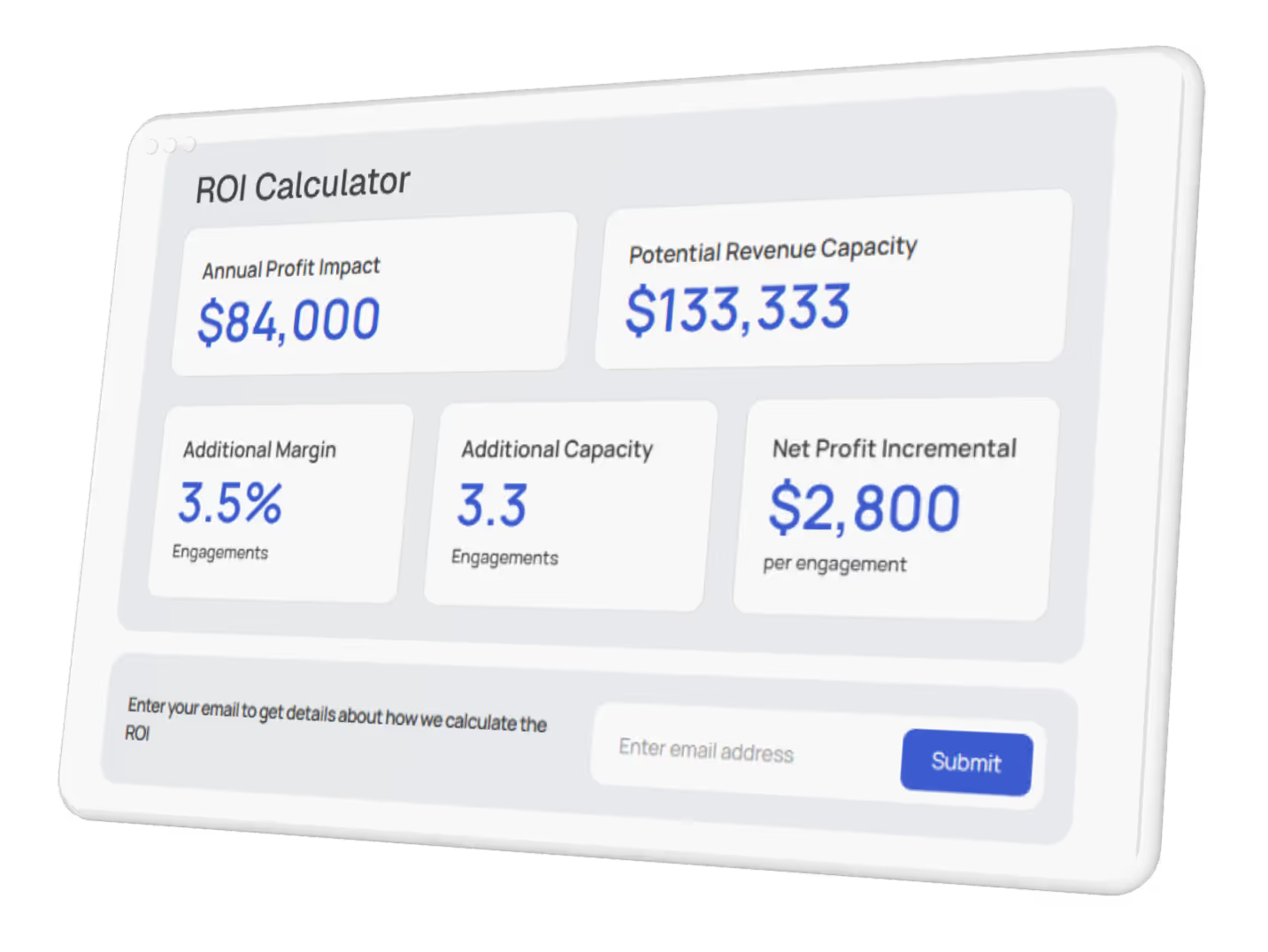
- ROI: AI solutions offer time and cost savings, reallocating resources to higher-value activities.
- Implementation is phased and manageable, with clear metrics for success.
- Outcome: AI turns compliance from a burden into a strategic advantage, improving efficiency and client trust.
Conclusion
In an era of accelerating regulatory change and heightened scrutiny, AI auditing tools are no longer a luxury but a necessity for audit firms. They transform compliance from a reactive burden into a proactive, efficient, and strategic function. By automating repetitive tasks, identifying risks earlier, and ensuring continuous readiness, AI empowers audit teams to deliver faster, more accurate results.
For audit firms, this means not only meeting regulatory requirements effortlessly but also gaining a significant competitive advantage. The strategic value of faster, more accurate compliance positions firms as leaders in the industry, building greater trust with clients and regulators alike. The next steps for audit teams ready to reduce their compliance workload involve exploring intelligent audit workspaces that integrate seamlessly and deliver measurable ROI.