



TL;DR
AI is revolutionizing audit reporting by enhancing efficiency, accuracy, and data analysis, with global investments reaching 30 billion in 2024. Key AI technologies include ML, NLP, RPA, and Generative AI, with projected internal audit adoption reaching 80% by 2026.
AI Transforming Audit Reporting
AI technology is reshaping audit reporting, moving it from a reactive, manual process to a proactive, insight-driven function. AI-driven insights allow auditors to process vast amounts of data with unprecedented speed and accuracy, leading to more comprehensive and reliable reports. This shift augments human capabilities with advanced analytical power, enabling auditors to uncover deeper insights and identify risks that might otherwise remain hidden. Platforms like Finspectors exemplify this transformation, combining automated evidence collection with intelligent risk assessment to streamline the entire audit reporting process.
AI adoption in internal audit is experiencing rapid growth, with expectations to double to 80% by 2026, a significant jump from 39% currently utilizing AI. This surge is driven by clear productivity and efficiency benefits, as highlighted by a survey by Internal Audit 360. Stakeholders increasingly demand that auditors prioritize AI for data analysis and quality management, underscoring the widespread belief that AI technology enhances audit reporting quality, according to a 2025 KPMG study.
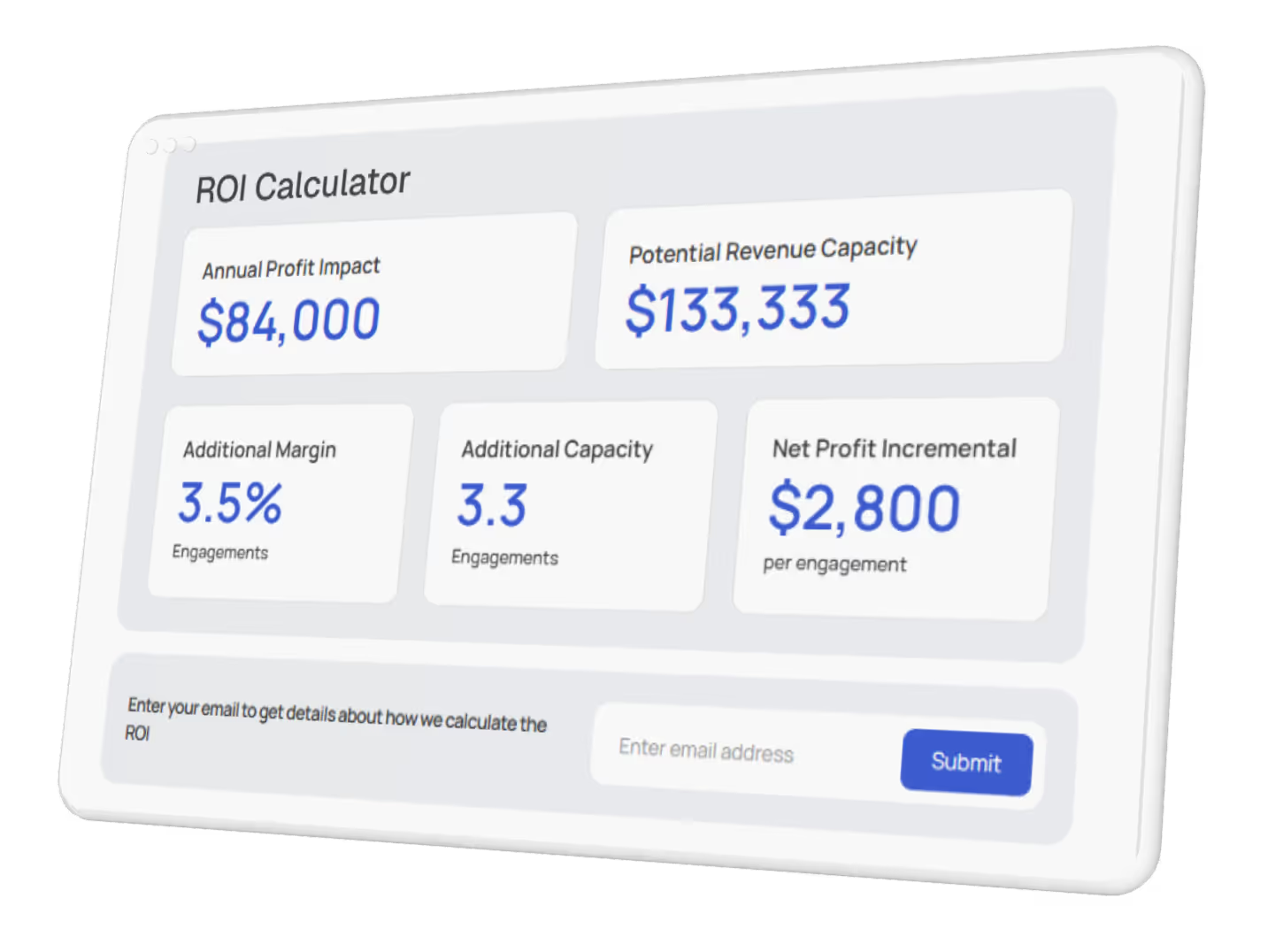
Global investments in AI technology solutions reached $130 billion in 2024, marking a 40.38% increase from the previous year, as reported by Exploding Topics. The impact is tangible, with AI tools demonstrating an approximate annual average ROI of $19,000 per user in professional sectors like accounting and auditing, contributing to an estimated $32 billion combined industry impact in the U.S.
What are the primary benefits of AI in audit reporting?
- Enhanced Efficiency: AI automates repetitive tasks, allowing auditors to focus on complex analysis and strategic insights.
- Improved Accuracy: AI algorithms can detect anomalies and patterns with greater precision than manual reviews, reducing human error.
- Deeper Insights: AI processes vast datasets to uncover hidden trends and risks, providing a more comprehensive view of an organization's financial health.
- Real-time Monitoring: AI enables continuous auditing, offering real-time insights into financial transactions and operational risks.
- Better Compliance: AI helps ensure adherence to regulatory requirements by automating checks and flagging potential non-compliance issues.
Core AI Capabilities for Auditors
AI technology offers a suite of powerful capabilities that are particularly beneficial for audit professionals. These capabilities extend beyond simple automation, delving into advanced analytics, predictive modeling, and natural language processing (NLP) to transform how audits are conducted and reported.
One key capability is the automation of data analysis. AI can ingest and analyze massive volumes of structured and unstructured data, identifying patterns, outliers, and potential risks far more quickly than human auditors.The State of AI in Accounting Report 2025 found that 41% of accountants use AI to automate workflows, streamlining routine tasks. Solutions like Finspectors leverage this capability to automate transaction matching, ledger reconciliation, and discrepancy identification across financial statements, allowing auditors to dedicate more time to value-adding activities.
Another crucial aspect is AI's ability to enhance risk assessment and fraud detection. This proactive approach helps auditors pinpoint high-risk areas for deeper investigation, significantly improving the effectiveness of audits.
Key AI technology solutions for audit reporting:
Machine Learning (ML):Used for anomaly detection, predictive analytics, and identifying complex patterns in financial data.
Natural Language Processing (NLP):Enables analysis of unstructured data such as contracts, emails, and legal documents to extract relevant information and identify risks.
Robotic Process Automation (RPA):Automates repetitive, rule-based tasks like data entry, reconciliation, and report generation.
Generative AI:Assists in drafting audit narratives, summarizing findings, and creating customized audit programs, as seen in Provectus's case study.
Computer Vision:Can be applied to analyze physical assets or documents, though less common in traditional financial auditing.
Automating Data Analysis and Reporting
Automation of data analysis and reporting is at the heart of AI's contribution to improving audit processes. Traditional auditing involves laborious manual data collection and analysis, prone to human error and time-consuming. AI technology streamlines these processes, allowing auditors to focus on interpretation and strategic recommendations rather than data crunching.
AI-powered tools perform continuous monitoring of transactions, flagging deviations from expected patterns or policy violations as they occur. This real-time capability is a significant upgrade from periodic audits, enabling organizations to address issues promptly. Multiple CA firms have implemented AI platforms like Finspectors for real-time transaction monitoring and anomaly detection, leading to a 70% reduction in processing time and 90% fewer data entry errors, alongside early fraud detection, as detailed in AI Accountant case studies. This shift towards continuous auditing is redefining the audit workflow with data analytics, allowing for more dynamic and responsive oversight.
How AI technology automates audit reporting:
- Automated Data Extraction: AI tools can extract relevant financial data from various sources, including ERP systems, spreadsheets, and scanned documents, reducing manual input errors.
- Pattern Recognition: Machine learning algorithms identify trends, anomalies, and potential red flags in large datasets that might be missed by human review.
- Report Generation: AI can automatically generate preliminary audit reports, summarizing findings, identifying key risks, and even suggesting areas for further investigation.
- Narrative Drafting: Generative AI can assist in creating clear and concise audit narratives, improving the quality and consistency of reporting, which is crucial for intelligent narrative drafting for audit workpapers.
- Compliance Checks: AI automates the verification of compliance with regulatory standards and internal policies, ensuring that all necessary checks are performed consistently.
AI integration facilitates the creation of customized audit programs based on documented risks and assertions, eliminating inefficiencies of over- or under-auditing. This tailored approach ensures audit efforts are directed where most needed, maximizing impact. Thomson Reuters highlights this benefit, stating that AI enables auditors to create customized audit programs, as discussed in their white paper on crafting an audit firm's AI strategy.
Enhancing Risk Assessment and Fraud Detection
One of the most impactful applications of AI-driven insights in audit reporting is enhancing risk assessment and fraud detection. Traditional methods rely on sampling and historical data, which can leave organizations vulnerable to sophisticated fraudulent activities. AI technology provides a more comprehensive and proactive approach.
AI algorithms can analyze vast datasets to identify subtle anomalies and behavioral patterns that are indicative of fraud. For example, the implementation of AI for real-time transaction monitoring has led to early fraud detection and reduced financial losses for multiple CA firms, as documented in AI Accountant case studies.
Beyond fraud, AI also improves overall risk assessment by identifying emerging risks and vulnerabilities. This allows auditors to prioritize areas of concern and allocate resources more effectively. Dawgen Global, for instance, implemented AI with explainability tools and automated drift detection, which resulted in a 30%+ improvement in fairness metrics for credit scoring and enhanced explainability for customer-facing decisions, as detailed in their AI Audit Case Study.
How AI technology strengthens risk assessment and fraud detection:
- Anomaly Detection: AI identifies transactions or activities that deviate significantly from established norms, often signaling potential fraud or errors.
- Predictive Analytics: Machine learning models predict future risks based on historical data and current trends, allowing for proactive mitigation strategies.
- Continuous Monitoring: AI systems constantly scan data streams for suspicious activities, providing real-time alerts to auditors.
- Network Analysis: AI can map relationships between entities (e.g., employees, vendors, transactions) to uncover collusive fraud schemes.
- Sentiment Analysis: NLP can analyze unstructured text data to gauge sentiment around financial activities or compliance, indicating potential reputational or operational risks.

Improving Audit Efficiency and Accuracy
The twin goals of audit-efficiency and accuracy-are significantly advanced through AI technology. By automating mundane tasks and providing sophisticated analytical capabilities, AI allows audit teams to complete engagements faster, with fewer errors, and with higher confidence in their findings. This translates directly into improved audit reporting that is both timely and reliable. Platforms such as Finspectors demonstrate this by combining automated evidence collection with intelligent risk scoring, enabling auditors to focus on high-value analysis rather than manual data preparation.
One clear example of efficiency gains comes from Checkfirst, a global certification firm that integrated AI tools with Salesforce for audit scheduling and reporting. This resulted in a 5x reduction in administrative costs and a 35% improvement in auditor utilization, saving hours per audit and enabling more projects, as highlighted in their case study. Such improvements allow audit firms to take on more clients or conduct deeper analyses for existing ones, enhancing their competitive edge.
Accuracy is bolstered by AI's ability to process and cross-reference data points without fatigue or oversight. This led to a 50% reduction in time-to-audit and a 20% increase in audit efficiency, with superior accuracy compared to manual processes, according to a Provectus case study. The ability of AI to validate data, identify inconsistencies, and even suggest corrections ensures that the final audit report is built on a solid foundation of verified information.
How AI technology boosts audit efficiency and accuracy:
- Reduced Manual Effort: Automates repetitive tasks like data reconciliation, sampling, and document review, freeing up auditors for higher-value activities.
- Faster Processing: AI can analyze millions of data points in minutes, significantly shortening audit cycles.
- Consistent Application of Rules: AI ensures that audit rules and criteria are applied uniformly across all data, eliminating human inconsistencies.
- Early Error Detection: Anomalies and errors are identified earlier in the process, reducing the cost and effort of remediation.
- Improved Sampling: AI can optimize audit sampling strategies, ensuring that the most relevant data points are selected for review, leading to more representative findings.
Implementing AI in Audit: Best Practices
Successfully integrating AI technology into audit reporting requires a strategic approach and adherence to best practices. It's not enough to simply acquire AI tools; organizations must develop a robust framework for deployment, governance, and continuous improvement. This ensures AI delivers its full potential while mitigating associated risks.
A crucial best practice is to start with clear objectives and a phased implementation. Thomson Reuters advises audit firms to craft a clear AI strategy, emphasizing that AI enables auditors to create customized audit programs based on documented risks, thereby eliminating over- or under-auditing, as detailed in their white paper.
Establishing strong AI governance is equally vital. This gap highlights a significant area for improvement.
Key strategies for implementing AI technology in audit:
- Define Clear Use Cases: Identify specific audit tasks or areas where AI can provide the most immediate and measurable value.
- Invest in Data Quality: AI models are only as good as the data they process; ensure data is clean, accurate, and accessible.
- Foster Collaboration: Encourage cooperation between audit teams, IT, and data scientists to build effective AI solutions.
- Provide Training: Equip auditors with the necessary skills to understand, interpret, and leverage AI-driven insights.
- Establish AI Governance: Develop policies and procedures for ethical AI use, data security, and model validation.
- Monitor and Iterate: Continuously evaluate AI model performance and refine strategies based on feedback and evolving needs, including implementing continuous audit loops for real-time feedback.

Future of AI in Audit Reporting
The trajectory of AI technology in audit reporting points towards an increasingly integrated and intelligent future. As AI capabilities evolve, they will further redefine the auditor's role, shifting focus from transactional verification to strategic advisory and continuous assurance. The future will see more sophisticated AI technology trends driving audit reporting efficiency and depth.
One major trend is the move towards continuous auditing and real-time monitoring. This proactive stance transforms audit from a historical review to a forward-looking risk management function.
Furthermore, the development of more advanced AI technology solutions, including explainable AI (XAI), will address concerns about AI's "black box" nature. This is critical for audit reliability, especially given that McKinsey's 2025 AI survey reports that 78% of companies use AI, with many actively mitigating risks including AI inaccuracy.
Emerging AI technology trends in audit reporting:
- Predictive Auditing: AI will move beyond anomaly detection to predict future risks and control failures before they occur.
- Hyper-personalization: AI will tailor audit scope and procedures based on an organization's unique risk profile and industry context.
- Ethical AI in Audit: Increased focus on developing and deploying AI models that are fair, transparent, and unbiased, with robust governance frameworks.
- Augmented Intelligence: AI will act as an intelligent assistant, providing auditors with insights and recommendations, but leaving final judgment to human experts.
- Blockchain Integration: Combining AI with blockchain technology for enhanced data integrity, traceability, and automated smart contract auditing.
- Leveraging Generative AI for Enhanced Audit Risk Intelligence: The use of generative AI will become more sophisticated, moving beyond simple report drafting to complex risk scenario generation and analysis, as discussed in leveraging generative AI for enhanced audit risk intelligence.
Conclusion
The integration of AI technology into audit reporting is a fundamental transformation. AI-driven insights empower auditors with unprecedented capabilities to enhance efficiency, accuracy, and analysis depth, moving the profession towards a more proactive, intelligent, and value-driven future. From automating data analysis and bolstering fraud detection to enabling continuous monitoring and generating comprehensive reports, AI technology solutions like Finspectors are proving indispensable.
As the audit landscape evolves, embracing AI best practices and staying abreast of emerging trends will be critical for audit firms to remain competitive and deliver superior value. The journey towards fully leveraging AI in audit reporting is ongoing, but the benefits-including significant ROI, reduced errors, and deeper insights-are clear and compelling. The future of audit reporting is undoubtedly AI-powered, promising a more robust and reliable financial oversight ecosystem.