



TL;DR
AI is enhancing audit risk assessment through automation of transaction analysis, anomaly detection, and continuous risk scoring. Machine learning, NLP, and predictive analytics improve risk identification; implementation and ROI considerations are covered for audit teams.
Why AI Is Transforming Risk Assessment
The auditing landscape is undergoing a profound transformation, driven by the integration of Artificial Intelligence (AI). Traditional manual risk assessment, fraught with time-intensive reviews, potential human error, and inconsistent scoring, is rapidly evolving. AI is empowering auditors to shift from reactive to proactive risk detection, automating critical processes that enhance efficiency and accuracy.
Today, audit teams can leverage AI to automate various aspects of risk assessment, from data analysis to continuous monitoring, allowing them to focus on high-value judgment calls. Finspectors.ai provides an intelligent audit workspace designed to streamline these processes, offering faster reviews and sharper insights.
Understanding AI-Powered Risk Assessment
AI risk assessment in auditing refers to the application of artificial intelligence technologies to analyze vast datasets, identify patterns, detect anomalies, and predict potential risks with greater speed and accuracy than manual methods. It transforms how auditors identify, evaluate, and respond to risks.
Key AI technologies employed include:
- Machine Learning (ML): Algorithms that learn from data to identify complex patterns and make predictions.
- Natural Language Processing (NLP): Enables AI to understand, interpret, and process human language from unstructured data like contracts and emails.
- Data Analytics: Tools and techniques used to extract insights from large datasets, often leveraging statistical models.
Unlike rule-based automation, which follows predefined instructions, intelligent AI systems can learn, adapt, and identify novel risk patterns without explicit programming, making them highly effective for managing audit risk with AI-powered automation.
Core AI Capabilities for Automating Risk Detection
AI offers auditors several powerful capabilities to automate and enhance risk detection:
- Automated Transaction Monitoring and Anomaly Flagging: AI algorithms can analyze billions of transactions, identifying deviations from expected behavior in real-time.
- Pattern Recognition for Fraud Indicators: Machine learning models excel at recognizing subtle, complex patterns indicative of fraud or unusual financial behaviors that might be missed by human review. Bank of America’s platform, for instance, processes over 4 billion transactions monthly at 99.8% accuracy, reducing false positives by 50% and detecting 65% more fraud than legacy systems (Deliberate Directions).
- Continuous Risk Scoring: AI systems can provide real-time risk scores that update dynamically as new data becomes available, enabling continuous auditing.
- Natural Language Processing (NLP) for Contract and Document Risk Analysis: NLP tools analyze unstructured text data in contracts, invoices, and other documents to identify risky clauses, compliance gaps, or inconsistencies. AI redlining tools, for example, achieve 50-90% reductions in contract review cycles with 90%+ accuracy rates (Sirion).
The following table compares different AI-powered risk assessment methods available to auditors, helping teams choose the right approach based on their audit complexity, data volume, and risk detection needs.
| Approach | Best For | Key Capabilities | Implementation Complexity | Typical Use Cases |
|---|---|---|---|---|
| Rule-Based Automation | High-volume, repetitive tasks with clear rules | Automated data extraction, basic validation, predefined alerts | Low to Medium | Simple compliance checks, data reconciliation |
| Machine Learning Models | Identifying complex, evolving patterns in large datasets | Anomaly detection, classification, fraud scoring | Medium to High | Fraud detection, expense categorization, transaction outlier identification |
| Natural Language Processing (NLP) | Analyzing unstructured text data | Contract clause extraction, sentiment analysis, document review | Medium | Lease agreement review, legal document analysis, email communication monitoring |
| Predictive Analytics | Forecasting future risks based on historical data | Risk scoring, probability assessment, early warning systems | Medium to High | Early fraud indicators, revenue recognition risk, going concern assessment |
| Hybrid AI Systems | Combining strengths of multiple AI approaches | End-to-end risk assessment, intelligent automation, expert systems | High | Comprehensive audit risk management, continuous auditing |
| Continuous Monitoring AI | Real-time, ongoing risk assessment | Live data feeds, automated alerts, dynamic risk dashboards | Medium to High | Continuous transaction monitoring, control testing, compliance checks |
Practical Applications: Where AI Adds the Most Value
AI significantly enhances audit effectiveness in several key areas:
- High-Volume Transaction Testing: AI can analyze 100% of transactions, moving beyond traditional sampling to identify anomalies across entire datasets. Mindbridge.ai, for instance, has analyzed billions of transactions, reducing audit prep time and uncovering discrepancies missed by manual methods (Mindbridge.ai).
- Identifying Related-Party Transactions: AI excels at mapping complex networks to detect undisclosed related-party transactions and potential conflicts of interest.
- Revenue Recognition and Expense Categorization: AI can flag unusual revenue patterns or expense miscategorizations that indicate potential misstatements or fraud.
- Compliance Monitoring: AI continuously monitors transactions and activities against multiple regulatory frameworks, flagging non-compliance in real-time. The EU AI Act, fully enforced by August 2026, sets strict requirements for high-risk AI systems, including those in finance (Unified AI Hub).
At Finspectors, we automate risk detection across these use cases, providing auditors with intelligent tools to automate risk assessment in audit workflows and enhance their review capabilities.
Implementing AI Risk Assessment in Your Audit Workflow
Implementing AI for risk assessment involves strategic planning and execution:
- Integration with Existing Systems: AI tools must seamlessly integrate with current audit management systems and data sources to ensure a cohesive workflow.
- Training AI Models: Models are trained on historical audit data and known risk patterns to improve their accuracy and relevance.
- Setting Risk Thresholds: Auditors define acceptable risk thresholds and customize detection parameters to align with engagement specifics.
- Balancing Automation with Professional Judgment: While AI automates detection, human oversight and professional judgment remain crucial for interpreting results and making final decisions.
Finspectors simplifies implementation with pre-built audit workflows, allowing teams to quickly leverage AI without extensive technical expertise. For a deeper dive into tools that can help, explore the top risk assessment automation tools for auditors.
Measuring ROI: Time Savings and Accuracy Improvements
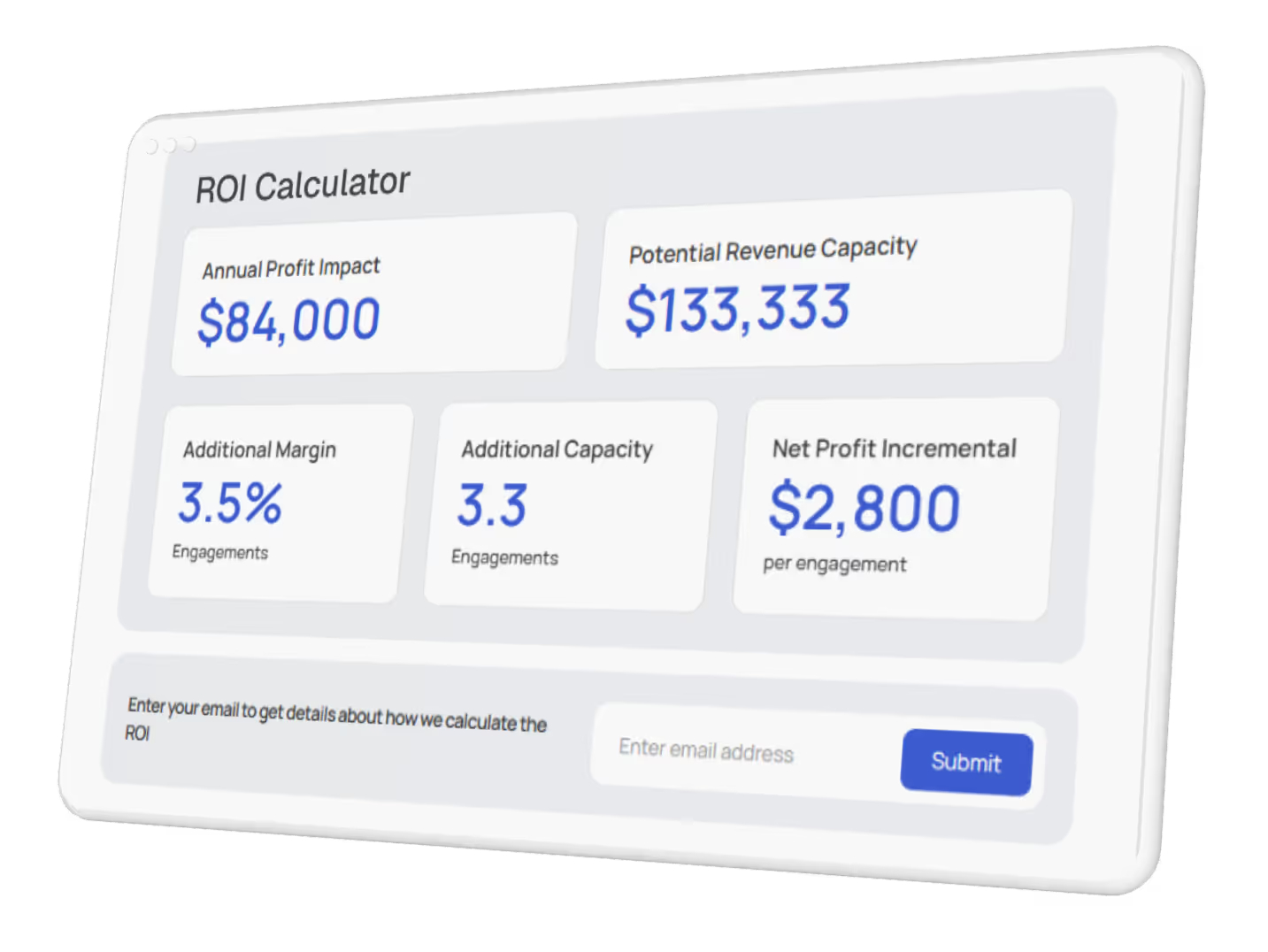
The return on investment (ROI) from AI-powered risk assessment is substantial, manifesting in both time savings and enhanced audit quality.
- Quantifying Hours Saved: AI significantly reduces time spent on manual screening and data analysis. Tasks like report generation and variance analysis, which once took hours, can now be completed more quickly with AI automation (Journal of Accountancy).
- Accuracy Improvements: AI enhances accuracy by reducing false negatives and providing more comprehensive coverage. Machine learning models often achieve over 99% accuracy in fraud detection, with significant reductions in false positives (Deliberate Directions).
- Enhanced Audit Quality: Consistent, bias-free risk evaluation leads to higher quality audits.
- Capacity Gains: Auditors can redirect their time from repetitive tasks to complex judgment calls and client advisory services. AI can save up to 8,000 audit hours annually and deliver 20-40% productivity gains (CPA Practice Advisor).
Finspectors users typically experience significant efficiency gains, allowing them to improve audit risk assessment accuracy with AI and focus on strategic insights.
Overcoming Common Implementation Challenges
While the benefits are clear, adopting AI for audit risk assessment comes with challenges:
- Data Quality Requirements: AI models are only as good as the data they train on. Poor data quality costs companies an average of $15 million annually (Keyrus). Auditors must ensure clean, relevant datasets.
- Managing Change Resistance: Building auditor trust in AI outputs and outputs requires clear communication and training. Only 28% of internal audit leaders are confident in their teams' ability to audit AI risks effectively (AuditBoard).
- Regulatory Compliance: Navigating evolving regulatory standards, like the EU AI Act, for AI use in audits is crucial.
- Explainability and Audit Trails: Ensuring AI-generated risk scores are explainable and traceable is vital for audit integrity.
Finspectors addresses these challenges by offering robust data governance features, transparent model outputs, and continuous training resources to empower audit teams. For more on this, read about how AI pattern detection reduces audit risk.
Key Takeaways
- Shift to proactive: AI transforms audit risk assessment from reactive to proactive, automating detection and enhancing accuracy.
- Core capabilities: Anomaly detection, pattern recognition for fraud, and continuous risk scoring.
- Efficiency: AI saves thousands of audit hours annually and boosts productivity.
- Implementation: Clean data, integration with existing systems, and auditor training are essential.
- Challenges: Data quality and change resistance must be addressed to realize AI's full potential.
- Human judgment: AI augments, rather than replaces, auditors; focus stays on higher-value tasks.
Conclusion
The integration of AI into auditing is not merely an enhancement; it's a fundamental shift in how firms approach risk assessment. With AI adoption among internal auditors projected to reach 80% by 2026 (Wolters Kluwer), firms that embrace this technology early will gain a significant competitive advantage.
AI acts as an augmentation, freeing auditors from repetitive tasks to apply their expertise to complex, nuanced issues. The future points towards advanced predictive risk modeling and continuous auditing, where AI provides real-time insights and auditors focus on strategic oversight. Finspectors is committed to helping audit teams implement intelligent risk automation, ensuring they are well-equipped for the next generation of auditing.