



TL;DR
ERP integration streamlines audit processes by connecting software directly to client systems, reducing manual data extraction and reconciliation. It boosts efficiency, accuracy, and continuous monitoring; implementation requires attention to security, compliance, and change management for strong ROI.
5 Ways ERP Integration Improves Audit Efficiency
ERP integration revolutionizes audit efficiency by automating tedious tasks and providing immediate access to critical information. This shift allows auditors to focus on higher-value activities, as highlighted by DataSnipper experts.
- Automated data extraction eliminates manual download and upload cycles, significantly reducing preparation time.
- Real-time access to financial records reduces waiting time for client data, accelerating the audit timeline.
- Continuous monitoring capabilities replace periodic sampling, enabling proactive risk identification according to Trullion's 2026 report.
- Standardized data formats reduce transformation and cleaning time, as data flows directly from the source.
- Reduced audit timelines with automated evidence collection, streamlining the entire verification process.
How Integration Enhances Audit Accuracy
Beyond efficiency, ERP integration profoundly enhances audit accuracy by minimizing human error and ensuring data integrity. Manual data entry error rates consistently range from 1-4%, while automated extraction achieves 99.5-99.959% accuracy in 2026 analyses.
- Direct source data access eliminates transcription and transfer errors inherent in manual processes.
- Version control ensures auditors work with current, unaltered records, preventing discrepancies from outdated information.
- Automated reconciliation catches discrepancies humans might miss, improving the reliability of financial statements.
- Complete audit trails provide transparency and reduce fraud risk, offering an undeniable record of all transactions.
- AI technology enhances audit quality by leveraging sophisticated algorithms to identify anomalies and patterns that indicate potential misstatements or fraud.
Implementation Considerations for Audit Firms
Implementing ERP integration requires careful consideration of several factors to ensure successful adoption and compliance. Audit firms must prioritize security and data privacy throughout the process.
- Security and Access Control: Robust security measures and granular access controls are paramount when connecting to client ERPs. SOC 2 Type II audits evaluate controls over 6-12 months, providing evidence like access logs and vulnerability scans for sustained effectiveness per Onspring.
- Data Privacy and Compliance: Adhering to regulations like GDPR and SOC 2 is non-negotiable. For cross-border transfers, firms must establish clear legal bases, conduct Transfer Impact Assessments (TIAs), and implement safeguards like encryption and pseudonymization. Hybrid cloud models, storing raw ERP audit data in the EU with global processing of metadata, are increasingly favored to maintain regional compliance according to Airbyte.
- Change Management: Training audit teams on integrated workflows is crucial. Internal audit AI use is projected to double to 80% by 2026, yet 46% report lower adoption than other business areas, highlighting a need for better training and skills development according to Wolters Kluwer.
- Platform Selection: Choosing between integration-ready audit platforms, like Finspectors, versus building custom connections depends on the firm's resources and client diversity. Finspectors leverages ERP integration to provide intelligent audit workspaces, automating risk scoring and accelerating financial review.
Real-World Impact: Efficiency Metrics and ROI
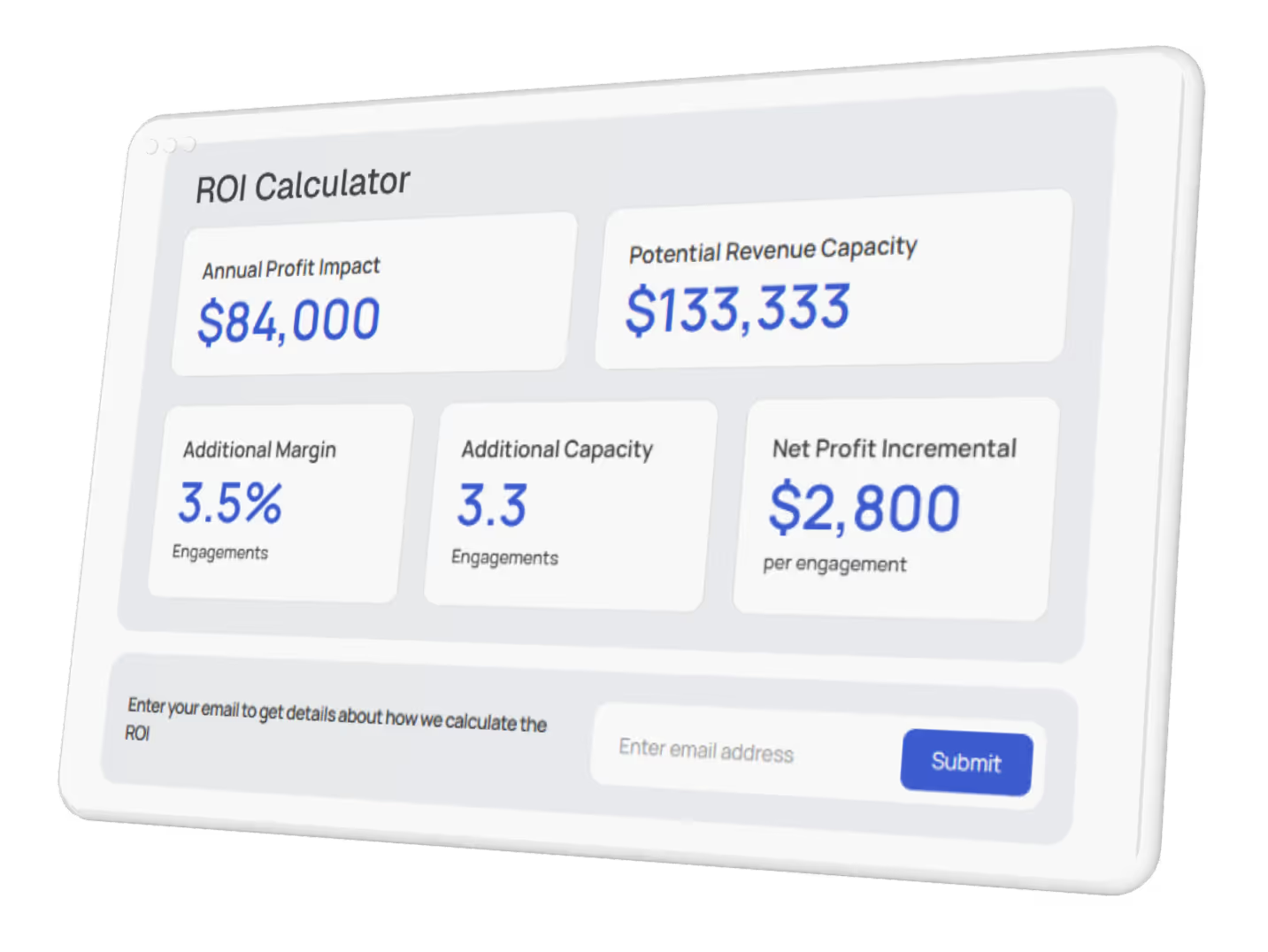
ERP integration delivers tangible benefits, translating into significant time savings, accuracy improvements, and a strong return on investment (ROI). Firms using CCH Axcess Engagement reported a 50% reduction in review time in one case study.
- Time Savings: Audit preparation and workpaper review can be up to 70% faster with AI automation in early adopter programs. TRU Solutions, for instance, reduced billing time by 98% using integrated solutions per ZoneandCo.
- Accuracy Improvements: Automated data extraction boasts 99.959% accuracy, drastically reducing the 1-4% error rates common in manual data entry according to Parseur. This eliminates transcription errors and ensures data reliability.
- Cost Benefits: While direct cost per audit hour reduction for 2026 is still emerging, broader finance automation delivers 20-30% cost relief, with intelligent automation cutting expenses by up to 70% in 2026 statistics.
- Client Satisfaction: Firms using integrated audit technology often see improved client satisfaction due to less disruption and faster turnaround times. This leads to 81% of finance leaders trusting audit firms using advanced technologies per Wolters Kluwer research.
The Future of ERP-Integrated Audits
The trajectory of ERP-integrated audits points towards increasingly intelligent, proactive, and real-time assurance. The shift to AI predictive analytics to improve audit accuracy is already underway.
- AI and machine learning (ML) capabilities, enabled by integrated data flows, will automate more complex tasks and provide deeper insights.
- Predictive risk scoring based on continuous ERP monitoring will allow auditors to identify potential issues before they materialize.
- Intelligent audit workspaces (e.g. Finspectors) leverage ERP integration to automate risk scoring and accelerate financial reviews.
- AI-powered auditing is revolutionizing business process controls by continuously monitoring transactions and flagging irregularities as noted by RTS Labs.
- The industry is moving from retrospective audits to real-time assurance - 58% of organizations conducted 4 or more audits in 2025 according to Secureframe; continuous monitoring can deliver 285%+ ROI per Sirion.ai.
This evolution, including improving audit efficiency with machine learning, promises to make audits more strategic and less resource-intensive.
Conclusion
ERP integration offers audit firms a dual advantage: significant efficiency gains and substantial accuracy improvements. By automating data extraction, providing real-time access, and enabling continuous monitoring, firms can drastically reduce audit cycle times and minimize errors. This not only optimizes internal operations but also enhances client satisfaction through faster, less intrusive audits. For more information, see AI technology enhances audit quality.
Before implementing ERP integration, audit leaders should consider key questions: What are our most pressing audit bottlenecks? How will this integration impact our existing workflows and talent? What are the security and compliance implications? And critically, what ROI can we expect from this investment?
Finspectors, for example, offers an intelligent audit workspace designed to streamline evidence collection, automate risk scoring, and accelerate financial review. Embracing ERP integration is no longer a luxury but a necessity for firms ready to modernize their audit technology stack and secure a competitive edge in an increasingly data-driven world. The benefits of audit automation for cost efficiency and accuracy are clear.
Key Takeaways
- Direct connection: ERP integration connects audit software to client systems, eliminating manual data handling.
- Efficiency: Automated data extraction, real-time access, and continuous monitoring significantly boost speed and throughput.
- Accuracy: Transcription errors drop, version control improves, and automated reconciliation strengthens reliability.
- Implementation: Plan for security, compliance (SOC 2, GDPR), and change management.
- ROI: Substantial time savings, reduced costs, and higher client satisfaction.
- Future: AI-powered predictive risk scoring and real-time assurance, enabled by integrated data.