



TL;DR
Modern audit software uses AI and machine learning to pinpoint transaction anomalies, duplicate entries, and financial discrepancies. This guide reviews top platforms, key detection features, benchmarking metrics, and best practices for better accuracy and fewer false positives.
How Modern Audit Software Improves Transaction Accuracy
Modern auditing demands unparalleled precision in identifying transaction anomalies and financial discrepancies. As financial transactions grow in complexity and fraud patterns evolve, auditors and CPAs require sophisticated tools to maintain accuracy and compliance. This guide explores the leading audit software solutions that leverage advanced technologies to provide the most accurate detection of transaction issues, helping firms mitigate risks and ensure financial integrity.
Audit software for transaction issues refers to specialized platforms designed to analyze financial data for irregularities, potential fraud, and compliance breaches. These tools automate the review of vast transaction volumes, identifying patterns and anomalies that manual processes often miss, thereby enhancing audit quality and efficiency.
Why Transaction Accuracy Matters in Modern Audits
The complexity of financial transactions and the sophistication of fraud patterns in 2026 present significant challenges for auditors. Financial fraud losses reached $12.5 billion in 2024 for consumers and businesses, a 25% year-over-year increase according to Alloy. The cost of undetected transaction errors is substantial, with organizations losing an average of 5% of annual revenue to fraud per a 2024 ACFE Report to the Nations. Missing these issues can lead to severe regulatory penalties, reputational damage, and significant financial losses.
AI and automation are transforming transaction analysis accuracy by enabling auditors to process massive datasets with speed and precision previously unattainable. These technologies reduce human error and provide deeper insights into financial health. Auditors must seek software that offers robust capabilities for anomaly detection, real-time monitoring, and seamless integration to navigate this evolving landscape effectively.
Key Features That Drive Transaction Issue Detection Accuracy
Accurate transaction issue detection hinges on several critical software features designed to identify anomalies efficiently.
- Machine learning algorithms for pattern recognition and anomaly detection: These algorithms learn from historical data to identify deviations from normal transaction behavior, flagging suspicious activities for further investigation.
- Real-time data integration and continuous monitoring capabilities: Continuous monitoring allows for immediate detection of issues as transactions occur, rather than post-factum.
- Duplicate transaction identification and reconciliation automation: Automated tools can swiftly identify and reconcile duplicate entries, overpayments, or missing invoices, which account for a significant portion of errors according to Fiscaltec.
- Threshold-based alerts and customizable risk scoring systems: These systems allow auditors to define acceptable parameters and receive immediate notifications when transactions fall outside these boundaries, prioritizing high-risk items.
Modern audit software, like Finspectors, emphasizes these features to provide comprehensive and precise transaction analysis. Learn more about best audit software for anomaly detection.
Top Audit Software Solutions for Transaction Analysis
The market offers several leading platforms specializing in transaction accuracy, each with unique strengths. These solutions are crucial for auditors seeking to enhance their detection capabilities.
Finspectors.ai, for instance, employs an AI-powered engine that scores every transaction in real-time to detect potential risks, flagging anomalies to refine audit focus on general ledger data and supporting documentation as noted by SoftwareFinder. Other prominent solutions include CaseWare IDEA and AuditBoard, which offer broad audit management capabilities with integrated analytics.
Integration with ERP systems and accounting software is paramount for seamless data flow. Most modern solutions offer APIs and connectors for popular platforms like SAP, Oracle, and NetSuite. Pricing models vary from per-user subscriptions to enterprise-level custom quotes, catering to firms of different sizes and budgets. For example, AuditBoard contracts can range from $42,000 to $148,000 for various modules over several months according to SmartSuite.
The following table provides a comparison of leading audit software platforms for transaction issue detection:
| Platform | Detection Accuracy Rate | Key Transaction Features | Best For | Starting Price Range |
|---|---|---|---|---|
| Finspectors AI Workspace | High (AI-powered real-time scoring, anomaly flagging) | Real-time AI transaction scoring, anomaly detection, general ledger analysis | Firms prioritizing AI-driven risk discovery and audit focus refinement | Custom pricing (contact vendor) |
| CaseWare IDEA | High (via 100+ pre-built tests, Benford's Law) | Duplicate detection, Benford's Law, fuzzy matching, journal entry testing | External audits, high-volume data analysis, fraud detection | Per-user license (contact vendor) |
| AuditBoard | High (integrated risk management, KRI automation) | Real-time dashboards, KRI automation, centralized visibility, NetSuite integration | Connected risk management, SOX compliance, enterprise GRC | Enterprise custom pricing (e.g., $42K-$148K+ annually) |
| MindBridge Ai Auditor | Very High (AI-powered anomaly detection, full dataset analysis) | Predictive analytics, continuous monitoring, financial anomaly detection | AI-driven assurance, risk-based audit planning, forensic analysis | Custom pricing (contact vendor) |
| Galvanize (Diligent) | High (risk-based analytics, continuous controls monitoring) | Automated risk assessments, compliance management, continuous monitoring | Integrated GRC, internal audit, compliance management | Custom pricing (contact vendor) |
| ACL Analytics | High (data extraction, analysis, continuous monitoring) | Data import from diverse sources, scripting for custom tests, fraud detection | Data analysts, internal auditors, compliance teams | Per-user license (contact vendor) |
How AI-Powered Tools Outperform Manual Transaction Reviews
AI-powered tools significantly outperform manual transaction reviews in terms of speed and accuracy, fundamentally transforming the audit process. Automated analysis can process billions of transactions per hour, a feat impossible for human teams according to ArcCompute.
The error reduction rates achieved through intelligent automation are substantial. AI financial forecasting reduces prediction errors by 15 - 30% compared to traditional models as per TechTimes. Wells Fargo's AI system, for example, achieved a significant reduction in fraud incidents through real-time detection, along with cost savings from fewer investigations as reported by DigitalDefynd. These tools excel at identifying subtle patterns, anomalies, and coordinated fraud schemes that human reviewers often miss due to volume and complexity.
However, human judgment remains critical for interpreting complex findings, assessing qualitative risks, and making strategic decisions. AI tools primarily serve to augment human auditors, handling the repetitive, data-intensive tasks. Finspectors, for example, leverages AI-powered anomaly detection to provide sharp insights, allowing auditors to focus on judgment rather than grunt work. For more information, see mastering anomaly detection.
Evaluating Accuracy: Metrics and Benchmarks That Matter
When evaluating audit software, understanding accuracy metrics is crucial. False positive rates, which indicate legitimate transactions incorrectly flagged as suspicious, directly impact audit efficiency. GPU-accelerated fraud detection systems, for instance, have achieved an 85% reduction in false positives according to ArcCompute. Conversely, detection sensitivity measures the software's ability to identify actual issues across various transaction types.
Industry benchmarks for transaction analysis accuracy in 2026 show that advanced AI systems achieve 99.8% accuracy in processing billions of transactions monthly as demonstrated by Bank of America. When testing software before purchase, firms should conduct pilot programs with diverse datasets, comparing the software's findings against known issues and manual reviews. Finspectors' accuracy metrics are designed to meet or exceed these industry standards, providing auditors with reliable detection capabilities.
For more insights into detection capabilities, explore anomaly detection in audit.
Implementation Best Practices for Maximum Detection Accuracy
Achieving maximum detection accuracy from audit software requires careful implementation and ongoing refinement.
- Proper system configuration and rule customization: Tailor the software's rules and thresholds to your industry's specific risks and regulatory environment.
- Training requirements for audit teams: Auditors need training on how to interpret AI-generated insights, manage alerts, and leverage the software's full capabilities. Organizations using dedicated compliance training software achieve 95% average completion rates per Continu.
- Data quality prerequisites for accurate transaction analysis: The adage "garbage in, garbage out" holds true. High-quality, clean data is fundamental for accurate analysis, as poor data quality can lead to significant annual losses according to Gartner research.
- Continuous improvement: Regularly refine detection rules based on audit findings, emerging fraud patterns, and feedback from the audit team to ensure the software remains effective against evolving threats.
By following these best practices, audit teams can ensure their software deployment yields the highest possible detection accuracy and efficiency. Mastering these techniques is key to mastering anomaly detection.
Key Takeaways
- Modern audits require advanced software to combat increasing transaction complexity and fraud.
- AI and machine learning are crucial for accurate transaction anomaly detection.
- Leading platforms like Finspectors, CaseWare IDEA, and AuditBoard offer specialized features.
- AI tools significantly enhance speed and reduce errors compared to manual reviews.
- Implementation: Data quality and continuous training are vital for maximizing accuracy.
- Evaluation: Assess software on detection rates, false positives, and integration capabilities.
Conclusion
Selecting the most accurate audit software for transaction issues is a strategic decision that can significantly impact an audit practice's efficiency, compliance, and overall risk management. Firms must meticulously match software capabilities to their specific audit requirements, considering factors like industry focus, transaction volume, and existing technological infrastructure.
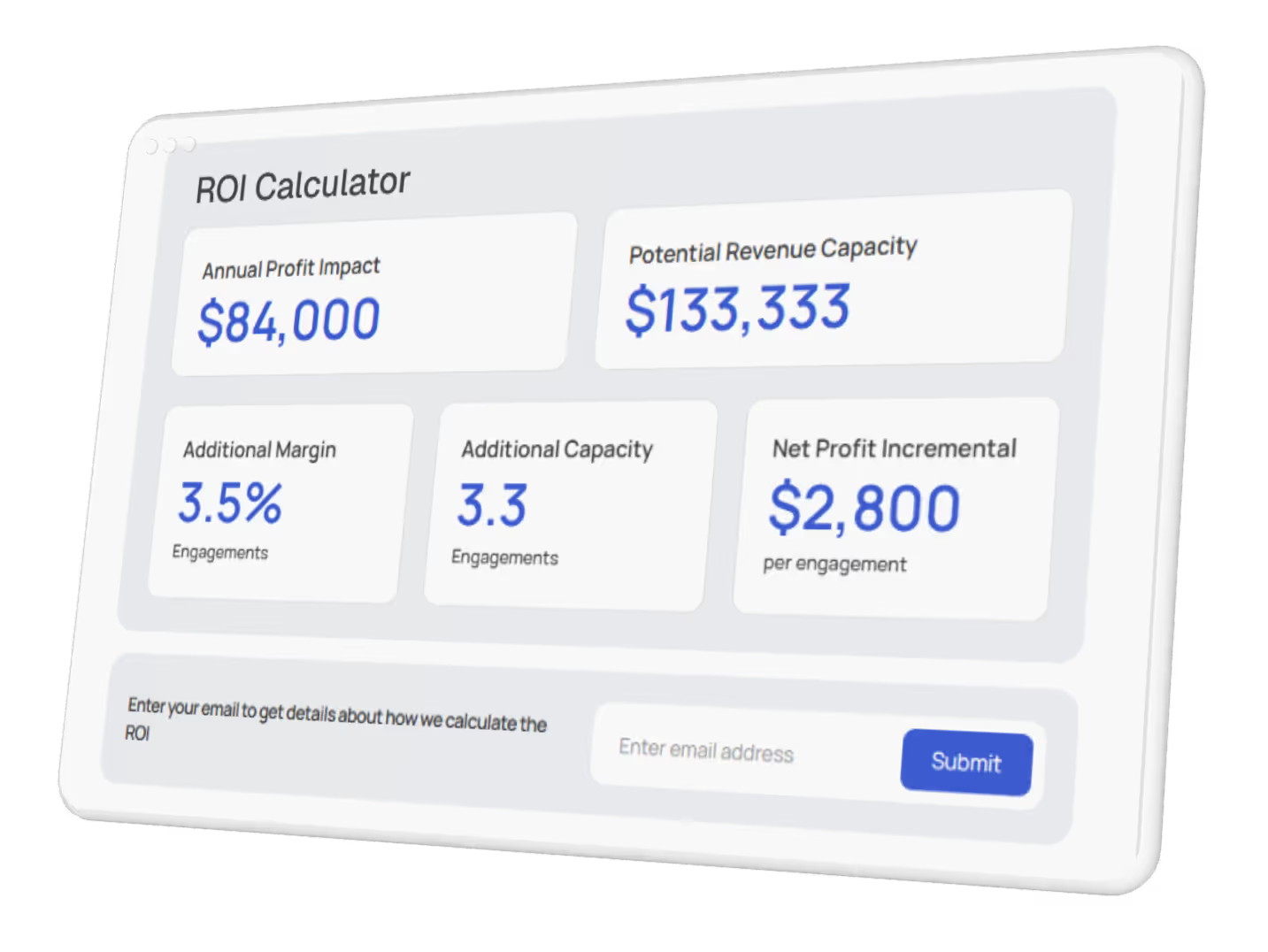
The return on investment (ROI) extends beyond initial costs, encompassing accuracy improvements, time saved, and the mitigation of regulatory penalties and reputational damage. Future trends in transaction analysis technology for 2026-2027 point towards even more sophisticated AI, real-time continuous auditing, and deeper integration across financial systems. Finspectors stands out for firms prioritizing transaction accuracy by offering an intelligent audit workspace designed for faster reviews, sharper insights, and seamless collaboration, allowing audit teams to focus on judgment rather than grunt work.