



What Makes a Risk Management Tool Actually Useful in Finance
Generic GRC platforms get repackaged for finance constantly. The feature lists look similar. The real difference shows up the moment a tool has to connect a flagged transaction to a workpaper without a manual step in between.
Risk identification vs. risk monitoring: why both matter
Risk identification finds the exposure. Risk monitoring tracks whether controls are holding. A tool that only does one of those two things leaves a gap that auditors fill manually, usually in a spreadsheet.
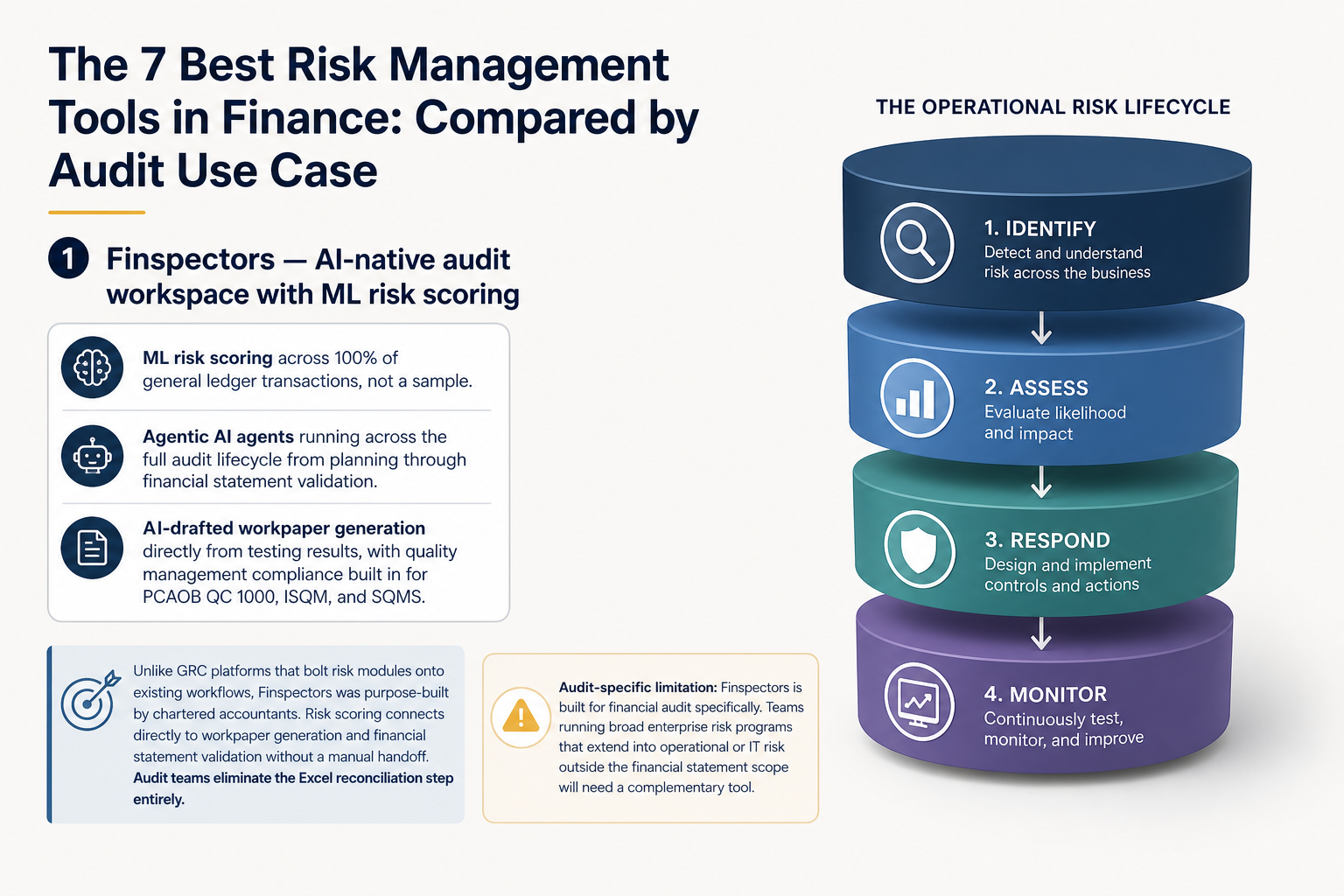
The operational risk lifecycle runs through four stages: identification, assessment, mitigation, and monitoring and reporting. A purpose-built financial risk tool needs to support all four. Most generic platforms concentrate on monitoring and reporting because that is where dashboards are easy to build and sell. Identification and assessment, the stages that require judgment and data depth, get left to the auditor.
Where most tools break down: the Excel handoff problem
The handoff from risk tool to workpaper is where most platforms stop. A risk score gets generated, exported to Excel, and then manually matched to evidence. That reconciliation step introduces delay, version control problems, and the kind of transcription error that reviewers catch only after the fact.
A useful enterprise risk tool eliminates that handoff entirely. Risk scoring and workpaper generation should operate in the same environment, not in two systems connected by a CSV file.
The four-stage operational risk lifecycle and what tools cover each stage
| What the tool must do | Where generic platforms fail |
|---|---|
| Score risk across 100% of transactions | Sample-based testing misses tail risk |
| Connect risk signals to workpaper evidence | Risk output stays in a separate dashboard |
| Support risk appetite vs risk tolerance thresholds | Thresholds are set manually with no enforcement |
| Monitor controls in real time | Monitoring is periodic, not continuous |
| Integrate with the internal controls framework | Framework for internal control is documented separately |
| Flag anomalies with audit trail | Anomalies require human review to surface |
Risk appetite sets the level of risk an organization is willing to accept in pursuit of objectives. Risk tolerance defines the acceptable variance around that level. Confusing the two during tool configuration produces thresholds that are either too loose to catch real exposures or so tight they generate noise that auditors learn to ignore.
The 7 Best Risk Management Tools in Finance: Compared by Audit Use Case
The tools below are evaluated against the four-stage operational risk lifecycle. Each entry follows a fixed format: best use case, key features, and the one limitation that matters most for audit teams.
1. Finspectors — AI-native audit workspace with ML risk scoring
Best for: Audit practices that need risk scoring, evidence testing, and workpaper generation inside a single workflow.
- ML risk scoring across 100% of general ledger transactions, not a sample
- Agentic AI agents running across the full audit lifecycle from planning through financial statement validation
- AI-drafted workpaper generation directly from testing results, with quality management compliance built in for PCAOB QC 1000, ISQM, and SQMS
Unlike GRC platforms that bolt risk modules onto existing workflows, Finspectors was purpose-built by chartered accountants. Risk scoring connects directly to workpaper generation and financial statement validation without a manual handoff. Audit teams eliminate the Excel reconciliation step entirely.
Audit-specific limitation: Finspectors is built for financial audit specifically. Teams running broad enterprise risk programs that extend into operational or IT risk outside the financial statement scope will need a complementary tool.
2. AuditBoard — enterprise GRC and audit management
Best for: Internal audit teams managing multiple audit types across a large organization with SOX compliance requirements.
- Risk-based audit planning with control testing workflows
- Issue tracking and remediation management
- Integration with enterprise compliance tracking software and SIEM tools
Reviewers of AuditBoard's risk module consistently note that risk documentation and actual evidence testing live in separate parts of the platform. The connection between a flagged risk and the workpaper supporting the conclusion requires manual effort to maintain.
Audit-specific limitation: Risk assessment outputs do not flow automatically into workpaper templates. Auditors must bridge that gap manually, which recreates a version of the Excel handoff problem.
3. MindBridge — AI-powered transaction risk analysis
Best for: Teams focused on anomaly detection and transaction-level risk scoring within the general ledger.
- AI-powered journal entry analysis with continuous risk scoring
- Anomaly detection across full transaction populations
- Risk tiering that prioritizes high-risk items for auditor review
MindBridge addresses the identification and assessment stages of the risk lifecycle well. The platform surfaces what to look at. What it does not do is generate workpaper documentation from those findings, so auditors move results into a separate system to complete the engagement.
Audit-specific limitation: Strong on risk identification; does not extend into workpaper generation, client request management, or financial statement validation.
4. Workiva — reporting, compliance, and risk documentation
Best for: Finance teams managing SEC reporting, ESG reporting software requirements, and connected compliance documentation across multiple frameworks.
- Connected data environment linking financial reports to underlying source data
- Risk and control documentation with version control
- ESG compliance checklist workflows and disclosure management
Workiva's strength is documentation integrity and cross-referencing across reports. Its risk module is designed for reporting risk, not transaction-level audit risk. Teams looking for an internal controls checklist environment with strong version control find it useful. Teams looking for ML risk scoring find it limited.
Audit-specific limitation: Not designed for transaction-level risk analysis. Risk scoring requires manual input rather than automated detection.
5. MetricStream — enterprise risk management and compliance tracking
Best for: Large organizations running enterprise risk assessment tools across multiple business units with regulatory compliance requirements.
- Integrated risk and compliance framework across operational, financial, and IT risk
- Vendor scorecard software capabilities for third-party risk management
- Policy and control management with workflow automation
MetricStream is a broad enterprise risk tool. Its depth across risk categories is a strength for enterprise-wide programs. For audit-specific teams, the breadth creates complexity. Configuring the platform for financial audit workflows requires significant implementation effort.
Audit-specific limitation: Implementation timelines for audit-specific configuration are long. Teams needing workpaper integration will build custom connectors or work outside the platform for that step.
6. IBM OpenPages — integrated operational risk and COBIT alignment
Best for: Financial institutions and regulated entities that need COBIT tools alignment and operational risk management within an existing IBM infrastructure.
- Operational risk management with regulatory capital calculation support
- COBIT alignment for IT risk and control frameworks
- Integration with IBM data and AI infrastructure
OpenPages fits organizations where IT risk and financial risk governance need to operate under one framework. The COBIT tools alignment is genuine and well-implemented. For teams outside the IBM ecosystem, integration overhead is significant.
Audit-specific limitation: Built for operational risk governance, not financial statement audit. Workpaper generation is not a native capability.
7. Diligent — board-level risk oversight and ESG compliance
Best for: Governance teams and CFOs managing board reporting, ESG compliance checklist requirements, and entity-level risk visibility.
- Board and committee reporting with risk dashboards
- ESG reporting software and ITAR compliance software adjacent workflows
- Business license software integration for entity management across jurisdictions
Diligent sits at the governance layer. It gives boards and CFOs visibility into risk posture and compliance status. It is not an audit execution tool. Teams that need risk data to flow into engagement workpapers will not find that capability here.
Audit-specific limitation: Designed for oversight, not audit execution. Risk data requires export and manual integration with audit workflows.
Summary Comparison
| Tool | Best for | Risk lifecycle coverage | AI-native? | Workpaper integration |
|---|---|---|---|---|
| Finspectors | Financial audit execution | All four stages | Yes | Native |
| AuditBoard | Internal audit management | Assessment, monitoring | No | Manual bridge |
| MindBridge | Transaction anomaly detection | Identification, assessment | Yes | None |
| Workiva | Reporting and ESG compliance | Documentation, monitoring | No | Limited |
| MetricStream | Enterprise GRC | All four stages (broad) | Partial | Custom build |
| IBM OpenPages | Operational and IT risk | Assessment, monitoring | Partial | None |
| Diligent | Board oversight and ESG | Monitoring, reporting | No | None |
How to Choose the Right Risk Management Tool in Finance for Your Team
A tool that accelerates a Big Four enterprise risk team can actively slow down a regional audit practice. The selection decision needs to be grounded in team size, audit scope, and integration requirements, not feature count.
Questions to ask before shortlisting any tool
Start with scope before evaluating features:
- Does the tool cover all four stages of the operational risk lifecycle, or only monitoring and reporting?
- Does risk scoring connect to workpaper generation without a manual export step?
- Can the tool ingest your full general ledger, or does it work on samples?
- How does the vendor handle the framework for internal control relevant to your engagements (COSO, COBIT, or both)?
- What does implementation and configuration actually cost, in time and in professional services fees?
A quick selection framework based on team context:
- If your team has fewer than 25 auditors and runs financial statement audits: Prioritize tools with native workpaper integration and ML risk scoring. Avoid platforms that require custom configuration to connect risk output to evidence documentation.
- If you are running enterprise-wide TPRM across multiple geographies: Prioritize tools with vendor scorecard software capabilities and multi-framework compliance tracking. Risk management tools finance teams use at the entity level are not the same as what enterprise risk programs need.
- If your primary need is ESG and board-level reporting: Prioritize Workiva or Diligent and pair with a separate audit execution tool.
Red flags in vendor demos that auditors should watch for
Vendor demos almost never run against real data volume. A platform that performs smoothly on a curated 10,000-transaction dataset can slow significantly against a 2-million-transaction general ledger. Ask vendors to demonstrate the tool under your data volume before committing.
Watch for demos that show risk dashboards without showing how a flagged item flows into a workpaper. If the vendor cannot demonstrate that connection in the demo, it does not exist natively. That gap will become your team's manual work.
Matching tool capability to your internal controls framework
Tool selection itself carries risk. Selecting the wrong platform based on optimistic demo conditions or management pressure to choose a preferred vendor is a procurement failure with real audit quality consequences. The fraud triangle applies here: pressure, opportunity, and rationalization can all shape a biased tool selection just as they shape a biased risk assessment. One structured evaluation against your specific framework of internal control requirements prevents that failure.
What Risk Management Tools in Finance Will Look Like by 2026
The tools available today represent the floor, not the ceiling. Auditors evaluating platforms now should be selecting against where capability is heading, not just what is available at the current release.
AI agents moving from risk flagging to risk resolution
Current AI in most risk tools flags anomalies and surfaces them for human review. The next generation moves AI agents from identification into resolution: drafting the audit response, updating the workpaper, and routing the finding through review workflow without manual intervention between steps.
This is already the operational model in AI-native audit platforms. By 2026, it will be the baseline expectation across the profession. Teams investing in platforms that stop at the dashboard are buying tools they will need to replace within two years.
ESG and third-party risk converging into one compliance layer
Third-party risk management is becoming more complex, not less. Geopolitical tensions, shifting tariff policies, and export controls mean that vendor risk now includes financial instability, human rights exposure, and sanctions screening in a single assessment. Chief compliance officers who manage these risks in separate systems are missing the connections between them.
ESG reporting software and TPRM capabilities are converging into unified compliance platforms. By the IIA GAM 2026 and AICPA and CIMA Engage 2026 conference cycles, the expectation is that risk tools provide a holistic view across financial, operational, and third-party risk rather than siloed dashboards. Teams attending Great Audit Minds 2026 and GAM conference 2026 are already hearing this framing from practitioners, not just vendors.
What Great Audit Minds 2026 signals about the profession's direction
The themes emerging from IIA GAM conference 2026 planning and AICPA Engage conference 2026 sessions point consistently toward one shift: AI in audit is moving from a differentiator to a baseline standard. Firms that are not using AI-native tools for risk assessment by the GAM 2026 cycle will be defending why, not choosing whether.
The profession is not waiting for tools to mature further. It is pushing platforms to match what practitioners already expect from AI in adjacent fields.