



TL;DR
Yes—AI can perform a wide range of audit testing procedures, from recalculations and three-way matches to full-population anomaly detection. But AI executes tests; auditors still design procedures, evaluate exceptions, and reach conclusions. The strongest results come when AI expands coverage and consistency while humans retain professional judgment.
What Audit Testing Actually Requires
Audit testing is not a single activity. It spans substantive procedures (testing balances and transactions), controls testing (evaluating design and operating effectiveness), and analytical procedures (identifying unusual trends or relationships). Professional standards require that procedures produce sufficient appropriate audit evidence—evidence that is relevant, reliable, and supports the auditor's conclusions.
Traditionally, firms relied heavily on statistical or judgmental sampling because testing 100% of transactions was impractical. AI changes the economics: when data is structured and accessible, auditors can test entire populations, apply consistent rules at scale, and prioritize exceptions for human review.

What AI Can Test Today
Modern AI audit platforms can automate or accelerate many testing workflows that previously consumed significant fieldwork hours:
- Recalculations and recomputations: Verify payroll, depreciation, interest, tax, and revenue calculations across full datasets.
- Three-way matching: Compare purchase orders, receiving documents, and invoices to detect unauthorized or duplicate payments.
- Cutoff and period-end testing: Flag transactions recorded in the wrong period based on shipping dates, service periods, or contract terms.
- Duplicate and ghost vendor detection: Identify similar vendor names, shared bank accounts, or suspicious address patterns.
- Journal entry analytics: Surface unusual manual entries, round amounts, off-hours postings, or entries by unauthorized users.
- Controls operating effectiveness: Test whether approvals, segregation of duties, and system-enforced controls occurred as designed.
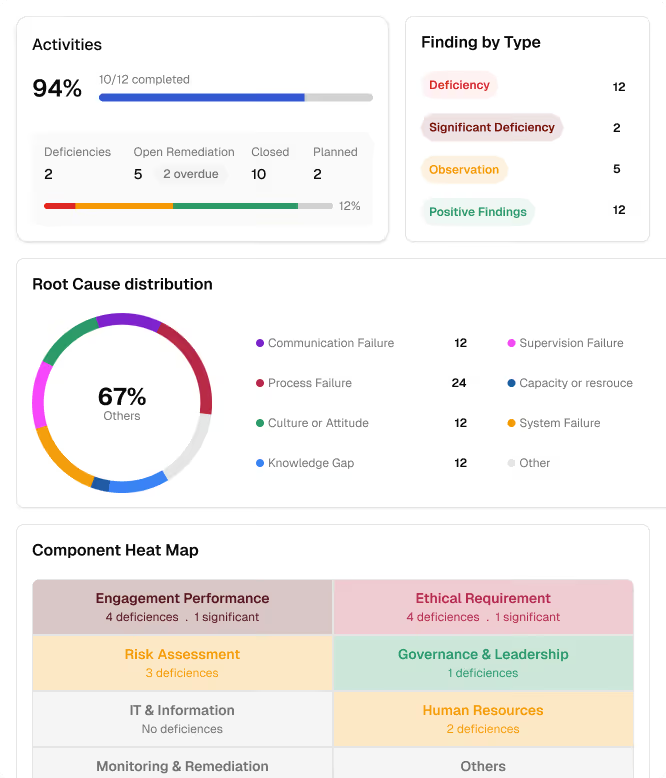
- Continuous monitoring: Run tests on a recurring basis instead of only at year-end.
AI Audit Testing Capability Matrix
| Audit testing area | What AI can do | What auditors must still do |
|---|---|---|
| Substantive transaction testing | Apply rules across 100% of transactions; flag exceptions and outliers. | Investigate exceptions, assess materiality, and conclude on assertions. |
| Controls testing | Verify control execution at scale; detect missing approvals or SoD violations. | Evaluate control design, assess deficiencies, and determine reliance. |
| Analytical procedures | Generate trend analysis, ratio comparisons, and peer benchmarking. | Explain variances, corroborate with other evidence, and assess reasonableness. |
| Fraud and anomaly detection | Identify statistically unusual patterns, Benford's Law deviations, and clustering. | Apply professional skepticism; distinguish errors from fraud indicators. |
| Documentation and workpapers | Log test parameters, outputs, timestamps, and reviewer notes automatically. | Ensure documentation meets ISA 230 / PCAOB requirements and tells a clear story. |
Where Human Judgment Remains Essential
AI excels at scale, speed, and consistency. It does not replace the auditor's responsibility to exercise professional judgment. Standards require humans to:
- Design the testing approach based on risk assessment, materiality, and assertion-level requirements.
- Evaluate data reliability before relying on analytics—source systems, completeness, and reconciliation matter.
- Investigate exceptions in context. A flagged transaction is a hypothesis, not a finding.
- Assess qualitative factors such as management integrity, industry conditions, and going concern indicators.
- Sign off on conclusions with accountability that cannot be delegated to an algorithm.
AI vs. Traditional Sampling: A Practical Comparison
| Dimension | Traditional sampling | AI-powered full-population testing |
|---|---|---|
| Coverage | Tests a representative subset of transactions. | Tests 100% of the population where data is available. |
| Detection power | May miss isolated or low-frequency exceptions. | Surfaces rare anomalies that sampling would likely miss. |
| Consistency | Varies by staff experience and manual execution. | Applies the same rules and thresholds every time. |
| Speed | Manual selection, testing, and documentation. | Automated execution with prioritized exception queues. |
| Documentation | Often spreadsheet-driven with manual notes. | Timestamped runs, parameter logs, and exportable workpapers. |
| Limitations | Lower cost for small populations; well understood by reviewers. | Requires clean, accessible data and clear governance over rules/models. |
How Firms Should Deploy AI Audit Testing
Successful adoption follows a phased, governed approach—not a wholesale replacement of existing methodology:
- Start with high-volume, rule-based tests. Duplicate payments, cutoff errors, and three-way match failures deliver quick wins with low model risk.
- Validate data before testing. Reconcile population totals to the general ledger and document source systems.
- Document parameters and versions. Capture rule sets, thresholds, and model versions in workpapers for reproducibility.
- Triage exceptions for human review. Use risk scoring to prioritize the highest-impact items for auditor investigation.
- Expand gradually. Add analytical and ML-based tests once teams trust the workflow and governance controls.
Common Misconceptions About AI Audit Testing
| Misconception | Reality |
|---|---|
| "AI replaces auditors." | AI executes tests at scale; auditors design, review, and conclude. |
| "More flags mean more findings." | High exception counts often reflect threshold tuning—not necessarily material misstatements. |
| "AI testing is always better than sampling." | Full-population testing requires reliable data; sampling remains valid when data is limited. |
| "Black-box models are fine if they're accurate." | Reviewers need explainability to defend procedures during inspection. |
| "Once configured, AI runs itself." | Ongoing governance, change control, and monitoring are required under ISQM 1. |
Final Thoughts
AI can perform audit testing—and in many areas, it can do so more thoroughly and consistently than manual sampling alone. The question is not whether AI can test; it is whether firms deploy it with the governance, documentation, and human oversight that professional standards require. When those controls are in place, AI audit testing becomes a force multiplier for coverage, quality, and efficiency.
Conclusion
AI can execute a broad range of audit testing procedures—from recalculations and controls verification to full-population anomaly detection—while auditors retain responsibility for design, investigation, and conclusion. Firms that combine AI-powered testing with clear methodology, defensible documentation, and professional judgment can expand audit coverage without compromising quality.
- Explore Finspectors: Book a demo to see AI-powered audit testing in action.