



Types of Audit Opinions: Definitions, Triggers, and Key Differences
Nearly one in four U.S. states failed to receive a clean audit opinion in 2026, according to a recent financial transparency assessment. That is not a data anomaly. It reflects what happens when financial reporting weaknesses go undetected until the opinion stage. For audit professionals, the cost of that discovery is real: reputational exposure, regulatory scrutiny, and stakeholder fallout that a late-stage correction cannot fully undo.
The four types of audit opinions each carry precise definitions, specific triggers, and distinct consequences. Audit teams that treat them as a formality, rather than a decision framework, are more likely to misjudge risk during fieldwork, issue the wrong opinion level, or face review challenges they could have prevented. This article gives you a precise reference for each opinion type, the conditions that trigger it, and how to respond when the evidence points toward a modified opinion.
What Is an Audit Opinion and Why the Type Matters
An audit opinion is the auditor's formal conclusion on whether financial statements present a fair view of an entity's financial position, in all material respects, under the applicable reporting framework. It is the product of every planning decision, risk assessment, and evidence test run during the engagement.
How an audit opinion differs from an audit report
The audit report is the full document delivered to stakeholders. It includes the scope of the audit, the basis for the opinion, key audit matters, and the opinion itself. The opinion is one specific paragraph within that report. Confusing the two leads to misreading what the auditor actually concluded and why.
Why opinion type affects stakeholder decisions
Opinion type directly shapes how investors, lenders, and regulators interpret financial statements. A clean opinion supports investor confidence and capital access. A qualified, adverse, or disclaimer of opinion raises questions about financial health and governance that stakeholders cannot easily dismiss. The financial statement audit opinion signals not just accuracy but the quality of the entity's financial reporting systems. For finance leads and audit partners, that signal determines how much work follows the report's release.
The Four Types of Audit Opinions Explained
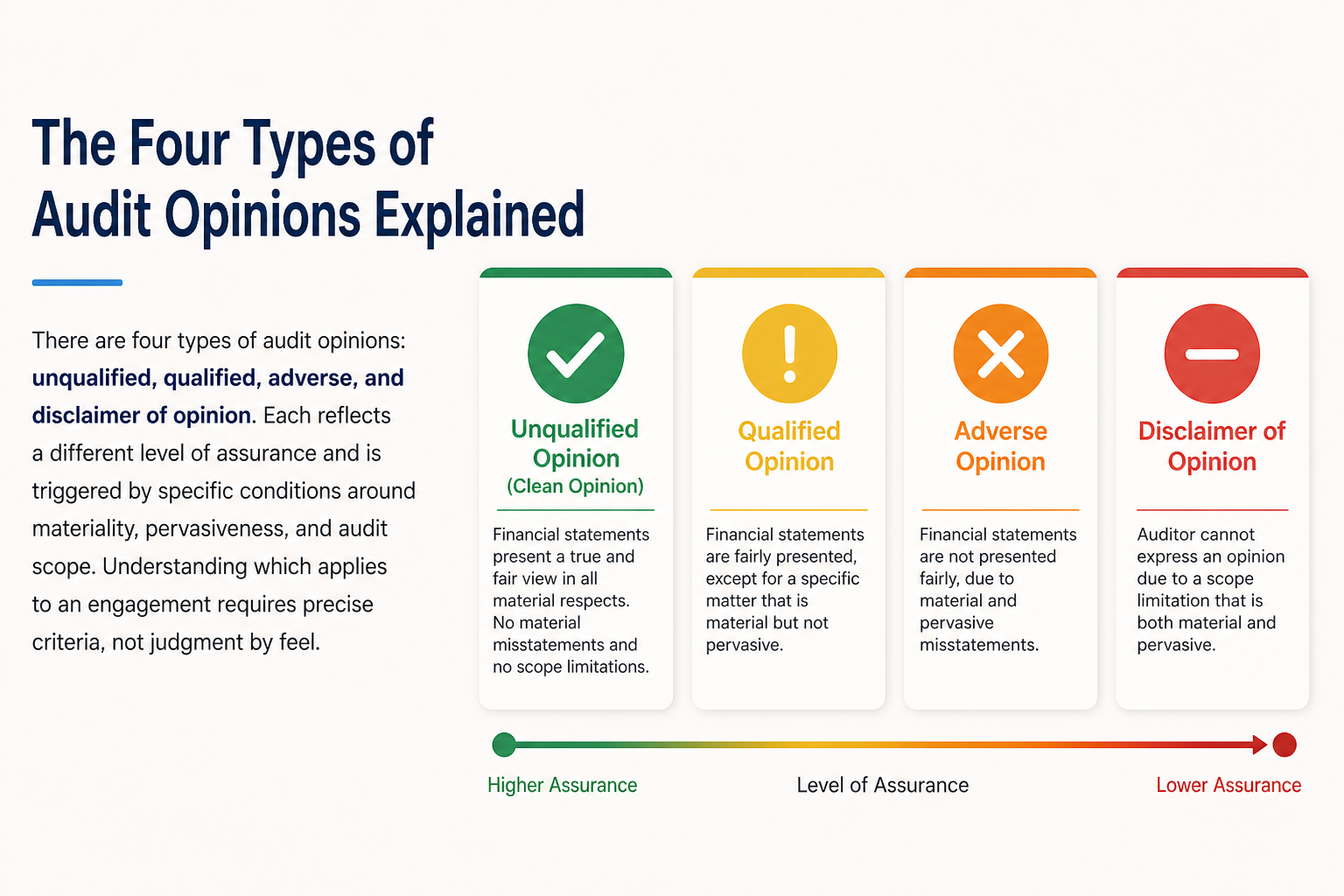
There are four types of audit opinions: unqualified, qualified, adverse, and disclaimer of opinion. Each reflects a different level of assurance and is triggered by specific conditions around materiality, pervasiveness, and audit scope. Understanding which applies to an engagement requires precise criteria, not judgment by feel.
Unqualified opinion (clean opinion): when financial statements pass
An unqualified opinion means the financial statements present a true and fair view in all material respects. The auditor found no material misstatements and faced no scope limitations. This is the best outcome for any entity. It signals that the financial reporting review process held up under scrutiny and that stakeholders can rely on the numbers presented.
Trigger: Financial statements comply with the applicable framework, and the auditor obtained sufficient appropriate evidence. Materiality threshold: No material misstatements identified. Auditor action: Issue standard unmodified report with clean opinion paragraph.
Qualified opinion: material but not pervasive misstatement or scope limitation
A qualified opinion means the financial statements are fairly presented, except for a specific matter. The auditor identifies a misstatement or scope limitation that is material but not pervasive. Pervasive means the issue does not affect the financial statements as a whole. This is the most common modified opinion type and the one most audit teams will encounter in practice.
Trigger: Material misstatement in a specific area, or the auditor could not obtain sufficient evidence for a defined portion of the audit. Materiality threshold: Material but not pervasive. Auditor action: Issue a qualified opinion with a "Basis for Qualified Opinion" paragraph that identifies the specific issue. Finance leads should treat this as an actionable finding, not a formality.
An audit report qualified opinion does not mean the entire set of financial statements is unreliable. It means one area requires attention and remediation before the next reporting period.
Adverse opinion: material and pervasive misstatements found
An adverse opinion is the most severe type of audit opinion. The auditor has concluded that the financial statements do not present a fair view, and the misstatements are both material and pervasive. Pervasive here means the errors affect the financial statements as a whole, not an isolated area.
Trigger: Misstatements are material, affect multiple interconnected areas, and fundamentally undermine the reliability of the financial statements. Materiality threshold: Material and pervasive. Auditor action: Issue an adverse opinion with a detailed "Basis for Adverse Opinion" paragraph. This opinion type typically triggers immediate regulatory and stakeholder escalation.
A qualified opinion in an audit report and an adverse opinion differ on one critical dimension: pervasiveness. Both involve material issues. Only the adverse opinion concludes the entire financial picture is unreliable.
Disclaimer of opinion: when the auditor cannot form a conclusion
A disclaimer of opinion does not express a conclusion on the financial statements at all. The auditor is unable to obtain sufficient appropriate evidence to form an opinion, and the possible effects of the limitation are both material and pervasive.
Trigger: Severe scope limitations, such as refusal to provide records, inaccessible information systems, or an engagement accepted too late to perform required procedures. Materiality threshold: Possible misstatements are material and pervasive, but the auditor cannot confirm the actual extent. Auditor action: Withdraw from the engagement if appropriate, or issue a disclaimer with a full explanation of the scope limitations. Investors and lenders treat a disclaimer with the same gravity as an adverse opinion.
What Triggers a Qualified or Adverse Opinion: Common Audit Mistakes to Avoid
Most modified opinions do not appear without warning. They develop from documentation failures, control weaknesses, and evidence gaps that accumulate across the engagement. Identifying these risks early is what separates proactive audit management from reactive opinion drafting.
Inadequate documentation of internal controls
When internal control documentation is incomplete or inconsistent, the auditor cannot rely on controls to reduce substantive testing. This forces expanded procedures and, if evidence remains insufficient, can result in a scope limitation and a qualified or disclaimer of opinion. The risk compounds when workpapers are rebuilt from scratch each engagement rather than maintained consistently.
Weak IT general controls and their audit trail impact
Weak IT general controls undermine the reliability of the audit trail. If access controls, change management, or system security are deficient, transaction-level data cannot be trusted without additional testing. When that testing cannot be completed within the engagement timeline, scope limitations follow.
Revenue recognition errors and inconsistent application of standards
Revenue recognition remains one of the most common sources of material misstatement, particularly in arrangements with bundled products or services. Inconsistent application of recognition principles across reporting periods creates exactly the type of material error that triggers a qualified opinion on an audit report, or worse, an adverse opinion if the issue is pervasive across multiple revenue streams.
Late or missing PBC submissions that create scope limitations
Late or missing provided-by-client submissions are a direct path to scope limitations. When client evidence arrives after fieldwork deadlines, the auditor cannot complete required procedures. If the affected area is material, the result is a qualified opinion. If the limitation is pervasive, a disclaimer becomes possible.
Catching these issues before the opinion stage requires continuous evidence monitoring across the full engagement, not a final-week review. Finspectors' AI-native audit workspace flags documentation gaps and reconciliation errors in real time, with ML risk scoring applied to 100% of transactions rather than a sample, so audit teams see emerging opinion risk before it becomes a finding.
How to Read and Respond to Types of Audit Opinions in an Audit Report
Receiving a modified opinion does not end the conversation. It starts a defined response sequence that, handled correctly, limits reputational and operational damage.
Reading the basis for opinion paragraph to identify the root cause
Every modified opinion includes a "Basis for Opinion" or "Basis for Qualified/Adverse Opinion" paragraph. Read this paragraph first. If it cites a scope limitation, the root cause is an evidence or access failure. The remediation path focuses on documentation and process. If it cites a misstatement, the root cause is accounting or reporting. The remediation path involves restated financials and corrected disclosures.
Immediate actions for finance leads when a qualified opinion is issued
If the basis paragraph identifies a specific misstatement, finance leads should immediately assess whether the issue requires a restatement or can be corrected in the next reporting period. Stakeholder communication should be direct and factual. Investors and lenders will read the audit report. A prepared explanation, before questions arrive, controls the narrative.
Escalation and remediation path for adverse or disclaimer opinions
An adverse or disclaimer of opinion requires board-level escalation on the day of issuance. Legal counsel and the audit committee should be engaged immediately. For an adverse opinion, the remediation path runs through financial statement restatement and control remediation before the next audit. For a disclaimer, the first step is removing the source of the scope limitation, whether that means improving record access, replacing information systems, or adjusting the engagement timeline.
Conclusion
Before the opinion is drafted, every audit team should be able to answer one question: do we have real-time visibility into documentation gaps, evidence quality, and scope limitations across this engagement? For teams running manual or Excel-based workflows, the honest answer is usually no. By the time a modified opinion becomes likely, the leverage to prevent it is gone.
Proactive audit execution means monitoring opinion risk throughout the engagement, not assessing it at the end. That is not an upgrade. It is the professional standard for any team responsible for issuing accurate, defensible opinions.
See how Finspectors gives audit teams real-time visibility into evidence gaps and opinion risk across every engagement. Request a demo to explore what that looks like in practice.