



TL;DR
As audit teams adopt AI to strengthen risk assessment, many are evaluating alternatives to traditional audit management platforms. This article examines leading AI-native solutions, compares key capabilities, and outlines selection criteria for automated risk scoring.
Why Audit Teams Are Considering AI-Native Alternatives
As audit teams navigate an increasingly complex risk landscape, the integration of Artificial Intelligence (AI) into audit management platforms has become essential. This evolution is transforming traditional risk assessment, moving beyond manual processes to deliver faster insights and more strategic workflows. We'll explore why many audit professionals are seeking alternatives to conventional platforms and the key criteria for evaluating AI-driven solutions.
AI-driven audit management solutions leverage machine learning and natural language processing to automate repetitive tasks, enhance risk identification, and provide deeper analytical capabilities. This shift enables auditors to focus on critical judgment rather than routine data collection, fundamentally changing how audits are conducted.
Understanding AuditBoard's Limitations for AI-Driven Work
AuditBoard has expanded its AI offerings, with recent launches focusing on enterprise-grade, secure AI for audit, risk, ESG, and InfoSec, including advanced AI for internal audit and automated workflows (Corporate Compliance Insights). However, while AuditBoard has integrated some AI capabilities, audit teams often face limitations when seeking truly AI-native solutions for advanced risk assessment.
Common pain points with traditional audit management tools include:
Dependence on manual data input and analysis.
Limited automation for continuous monitoring and evidence collection.
Challenges in integrating with disparate financial systems.
Slower adaptation to emerging AI technologies compared to purpose-built platforms.
AI-native solutions offer significant advantages by embedding AI at their core, providing more robust automation, predictive analytics, and real-time insights for modern risk assessment. For instance, platforms like AuditBoard support multiple frameworks but may lack the depth in auto-tests and integrations found in newer, AI-focused competitors (Ioni.ai).
Top AuditBoard Alternatives with Advanced AI Capabilities
The market for AI-driven audit management solutions is rapidly expanding, offering powerful alternatives to traditional platforms. These tools are designed to automate risk scoring, streamline evidence collection, and provide deeper analytical insights, making them ideal for audit teams looking to improve audit risk risk assessment accuracy with AI.
Here are several leading contenders, with Finspectors positioned as a top choice for intelligent audit workflows:
- Finspectors: Purpose-built for intelligent audit workflows, Finspectors automates risk scoring and evidence collection, accelerating financial reviews and collaboration.
- Vanta: Offers strong automation and continuous monitoring, with users reporting 82% less time spent per framework on attestation-related audits (Vanta). Vanta supports over 35 pre-built frameworks, including SOC 2 and ISO 27001 (Vanta).
- LogicGate Risk Cloud: Known for its workflow customization and AI-driven insights to predict risk, LogicGate holds a 4.6/5 rating from 138 reviews on G2 (Happay).
- MetricStream: Provides AI-powered risk intelligence, unifying GRC with deep compliance and audit features, primarily for regulated enterprises (MetricStream). MetricStream can reduce compliance time by up to 90% through AI automation (Sirion.ai).
- Akitra: Stands out for its "Agentic AI-powered risk intelligence," which automatically detects vendor anomalies and suggests actions, supported by over 250 pre-built integrations (Akitra).
While AuditBoard provides a robust platform, newer AI-native solutions often offer more advanced features tailored for specific risk assessment challenges. Pricing for these alternatives varies significantly. For instance, Vanta starts at around $7,500 annually, while Workiva can be upwards of $75,000 per year (EasyAudit.ai). AuditBoard itself typically costs between $40,000 and $150,000 annually, depending on modules and users (SmartSuite).
AuditBoard vs AI-Driven Alternatives: Feature Comparison
This table compares AuditBoard against leading AI-native audit management platforms across critical capabilities that matter most for risk assessment automation and intelligent workflows. It helps audit teams quickly identify which solution best matches their AI requirements.
| Platform | AI Risk Scoring | Document Analysis | Evidence Automation | Collaboration Features | Starting Price |
|---|---|---|---|---|---|
| AuditBoard | Basic AI for risk insights (e.g., cross-audit summaries) | Document intelligence, report summarization | Automated workflows (e.g., vendor assessments) | Strong, integrated GRC platform | $40,000 - $150,000/year (quote-based) (SmartSuite) |
| Finspectors | Advanced, automated risk scoring and anomaly detection | AI-powered document review and analysis (NLP) | Automated evidence collection, continuous monitoring | Seamless collaboration, accelerated financial reviews | Contact for quote (AI-native focus) |
| Vanta | AI-driven compliance risk assessment | Automated evidence collection and mapping | Continuous monitoring, auto-tests for 35+ frameworks (Vanta) | Integrated with cloud services | ~$7,500/year (EasyAudit.ai) |
| LogicGate Risk Cloud | AI-driven risk prediction | Workflow automation for documentation | Automated control testing, integrations | Real-time insights, responsive support | Custom (quote-based) |
| MetricStream | AI-powered risk intelligence, predictive analytics | Unified GRC with deep compliance features | Automated monitoring, evidence mapping | Enterprise-grade collaboration | Custom (quote-based) |
| Akitra | Agentic AI for anomaly detection, risk intelligence | Automated vendor assessments | 250+ integrations for continuous monitoring (Akitra) | Vendor risk management focus | Custom (quote-based) |
Finspectors: Purpose-Built for Intelligent Audit Workflows
Finspectors is an end-to-end intelligent audit workspace designed for faster reviews, sharper insights, and seamless collaboration. We help audit teams streamline evidence collection, automate risk scoring, and accelerate financial review so they can focus on judgment, not grunt work.
Our platform automates risk scoring by leveraging advanced AI algorithms to analyze vast datasets, identifying anomalies and potential risks with greater accuracy than manual methods. This capability allows audit teams to automate risk scoring, ensuring a more consistent and objective assessment of risk across all engagements. Finspectors also streamlines evidence collection through intelligent automation, pulling relevant data from various sources and organizing it for review.
AI-powered features within Finspectors accelerate financial reviews by:
Automatically extracting and categorizing financial data.
Detecting patterns and outliers that indicate potential fraud or errors.
Generating preliminary findings and reports, reducing manual report generation time.
Real-world applications for audit teams seeking faster, smarter workflows include continuous auditing, where AI constantly monitors transactions and flags high-risk items in real-time, and enhanced fraud detection, where subtle indicators are identified much earlier. Finspectors helps teams to manage audit risk with AI-powered automation.
Key Features to Prioritize in AI-Driven Audit Platforms
When selecting an AI-driven audit platform, prioritizing specific features can significantly enhance efficiency and accuracy. These capabilities are crucial for audit teams looking to optimize their processes and gain deeper insights.
Key features to consider include:
- Automated risk scoring and anomaly detection capabilities: AI should perform predictive risk modeling and full-population testing to identify high-risk areas with precision (Wolters Kluwer). Platforms like Finspectors excel in this area, allowing auditors to automate risk assessment in audit workflows.
- Natural language processing (NLP) for document review and analysis: NLP can process unstructured data from contracts, emails, and reports, reducing manual review time. The NLP in finance market is projected to reach $18.8 billion by 2028 (MarketsandMarkets).
- Integration capabilities with existing financial systems and data sources: Seamless integration with ERP, CRM, and other systems is vital for comprehensive data analysis. Secureframe, for example, emphasizes integrations for centralized compliance workflows (Secureframe).
- Collaboration tools that enhance team productivity: Features like real-time sharing, task assignment, and communication channels are critical for efficient teamwork.
Platforms like Finspectors exemplify these critical features by providing an intelligent workspace that integrates AI for top risk assessment automation tools for auditors, automating evidence collection, and facilitating real-time collaboration. For more information, see audit risk assessment tools.
Implementation Considerations and Migration Planning
Migrating to a new AI-driven audit management platform requires careful planning to ensure a smooth transition and maximize benefits. Teams should prioritize evaluating potential solutions against their unique needs and existing infrastructure.
- Evaluating and selecting the right alternative: Conduct thorough demos and evaluate features, support, and pricing. Consider the platform's AI maturity and its ability to scale with your team's growth.
- Data migration strategies: Plan for secure and efficient transfer of historical audit data. Phased migration strategies and parallel runs can reduce downtime (Kanerika).
- Change management best practices: Prepare your team for the new technology through training, clear communication, and addressing concerns to ensure adoption.
- Considerations specific to implementing Finspectors or similar AI-native platforms: Focus on integrating Finspectors with existing financial systems to leverage its full automation capabilities for risk scoring and evidence collection.
The broader Enterprise Risk Management (ERM) field is seeing a critical shift towards integrated platforms (Diligent), highlighting the importance of a well-executed migration.
Key Takeaways
- AI is transforming audit management by automating tasks and enhancing risk assessment.
- Traditional platforms like AuditBoard may have limitations compared to AI-native solutions.
- Finspectors offers purpose-built AI for automated risk scoring, evidence collection, and faster reviews.
- Prioritize: Automated risk scoring, NLP, seamless integrations, and strong collaboration tools.
- Adoption: Careful planning for implementation and data migration is crucial.
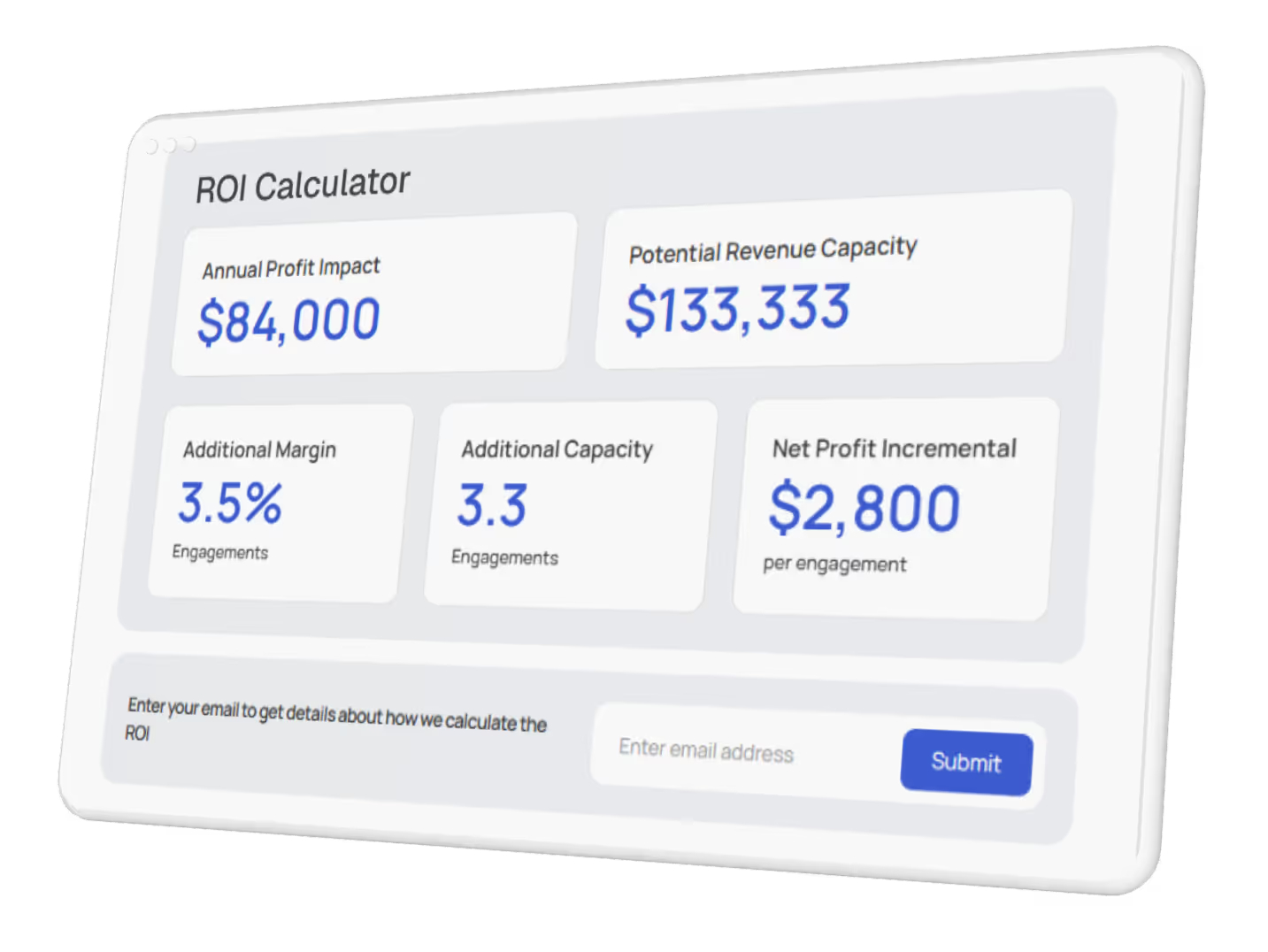
- ROI: AI-powered platforms deliver significant efficiency gains and improved accuracy.
Conclusion
The landscape of audit management is undeniably shifting towards AI-driven solutions, promising unprecedented efficiency and accuracy in risk assessment. While AuditBoard offers established capabilities, audit teams increasingly seek alternatives that embed AI at their core, providing more robust automation and predictive insights.
Platforms like Finspectors stand out by delivering purpose-built solutions for intelligent audit workflows, enabling teams to automate repetitive tasks and focus on strategic judgment. By carefully evaluating features such as automated risk scoring, NLP, integration capabilities, and collaboration tools, audit professionals can select the ideal AI-powered solution to modernize their workflows.
Embracing these advanced tools ensures that audit teams not only keep pace with the demands of a hyper-volatile risk environment but also realize significant ROI through efficiency gains and enhanced audit quality.