



Why Audit Client Friction Follows Predictable Patterns
Difficult audit clients are rarely random. The friction almost always traces back to three sources: information asymmetry, fear of findings, or unclear engagement scope. When you know which one is driving the behavior, you stop reacting and start diagnosing.
The Three Most Common Difficult-Client Archetypes in Audit
The Stonewaller delays document submissions and blames internal processes. They are usually protecting a finding they already know exists. The Disputer challenges every conclusion, not because the evidence is wrong, but because the finding threatens a metric they care about. The Scope Creeper keeps adding requests outside the engagement letter, often because the original scope was never properly defined.
Each archetype responds to a different intervention. Treating a Disputer like a Stonewaller makes the situation worse.
Why the Same Client Behaves Differently Across Engagement Phases
A CFO who cooperated fully during planning may become combative during fieldwork when a significant finding surfaces. This is not inconsistency. The stakes changed.
Difficult behavior is subjective and tied to viewpoints and expectations. A CFO disputing a right-of-use asset classification may be protecting a bonus metric tied to EBITDA, not deliberately obstructing the audit. Pausing to understand their background and the pressure they are under allows you to respond rather than react. That shift from reaction to response is where auditor skills become a professional advantage, not just a soft-skills talking point.
Step 1 — Validate Before You Escalate
De-escalation is not weakness. It is the fastest path back to audit progress. The auditor who validates the client's concern keeps the conversation moving. The one who gets defensive loses an hour and still has to resolve the underlying issue.
Phrases That Defuse Pushback Without Conceding Ground
Use language that acknowledges the concern and redirects toward a solution:
- "I hear that this timeline is creating pressure on your side. Let me show you exactly where we are and what we need to move forward."
- "I understand this finding is unexpected. Walk me through your read of the transaction and we'll look at the evidence together."
- "That's a fair question. Here's what the engagement letter specifies and here's what I can do within that scope."
None of these concede the audit position. All of them keep the relationship functional.
What Never to Say During a Difficult Audit Conversation
Certain phrases shut conversations down and signal to the client that you are not a partner in resolving the issue. Avoid these completely:
- "Calm down."
- "That's not my fault."
- "You misunderstood."
- "There's nothing I can do."
- "That's just our policy."
Each of these sounds dismissive or defensive and validates a client's instinct to escalate. Replace them with language that names the concern, accepts shared responsibility for finding a path forward, and points toward a concrete next step. That is what professional language looks like in practice. It validates the concern and points toward a solution.
Step 2 — Anchor Every Dispute to Evidence, Not Opinion
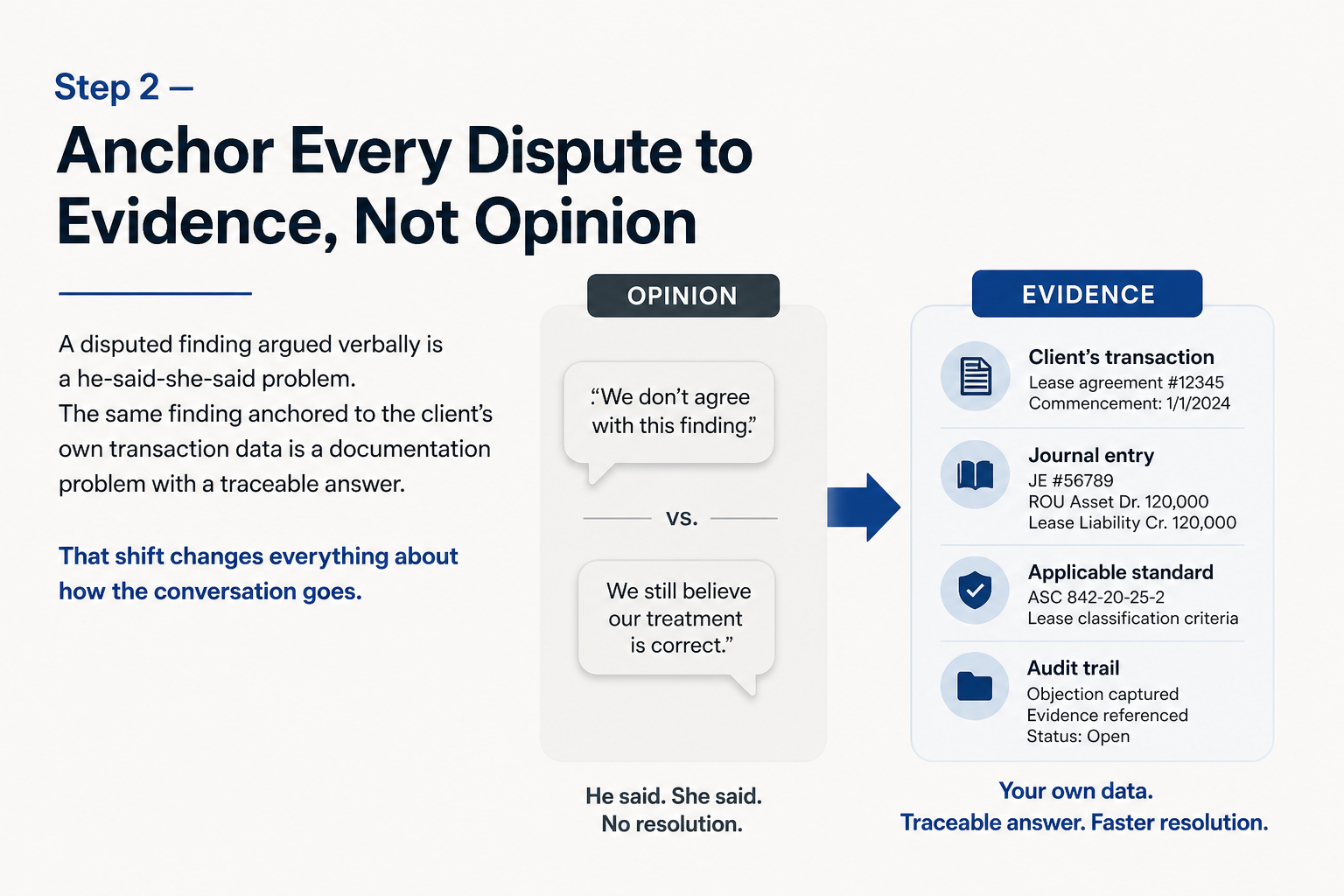
A disputed finding argued verbally is a he-said-she-said problem. The same finding anchored to the client's own transaction data is a documentation problem with a traceable answer. That shift changes everything about how the conversation goes.
Turning a Disputed Finding Into a Document Trail
When a client disputes a lease classification or challenges a right-of-use asset balance on the balance sheet, the fastest resolution is not a longer explanation of FASB and GASB standards. It is showing them the specific transaction, the journal entry, and the applicable standard in the same view.
Clients who dispute right-to-use treatment are often unfamiliar with the accounting standard rather than acting in bad faith. Anchoring to the standard and the client's own data resolves disagreements faster than any verbal debate. Build a document trail from the first point of dispute: capture the client's objection in writing, reference the specific evidence, and log the status. That trail protects the engagement if the dispute escalates.
How Real-Time Evidence Access Changes the Power Dynamic
When auditors access evidence in real time during the meeting, the dynamic shifts from "auditor's opinion versus client's opinion" to "your own data versus your own data." The client can no longer argue against a finding without arguing against their own records.
Finspectors makes this possible mid-engagement. Its ML risk scoring covers 100% of transactions and surfaces flagged items in a shared audit workspace that both auditor and client can reference, eliminating the factual ambiguity that fuels most difficult client exchanges before it starts.
Step 3 — Own Legitimate Errors Immediately and Completely
When the audit team makes a mistake, the instinct is to minimize or hedge. That instinct is wrong. Delayed or vague ownership converts a manageable problem into a relationship-ending one.
The Four-Part Error Response Sequence
Follow this sequence every time an audit-side error surfaces:
- Own the issue. Acknowledge directly that the error occurred and that you understand the impact on the client. Do not wait for the client to escalate it.
- Be transparent. Tell the client what happened, how it occurred, and how you plan to fix it. Avoid language like "sorry if this caused inconvenience." Say "sorry for the inconvenience." The difference matters more than it sounds.
- Solve the problem. Correct the workpaper, notify the reviewer, and confirm the fix is complete before informing the client. Give a realistic timeline with a small buffer built in.
- Communicate after the fix. Confirm resolution in writing. State what you learned and what process change prevents recurrence. This closes the loop and restores credibility.
Communicating After the Fix to Close the Loop
The fourth step is the one most audit teams skip. Clients remember whether the fix was confirmed. A brief written summary after the issue is resolved does more for the relationship than the original apology. It signals that the team is operating with discipline, not just reacting.
Step 4 — Enforce Scope With the Engagement Letter, Not a Conversation
Scope disputes feel personal. They do not have to be. The engagement letter is a neutral document. When you reference it correctly, it becomes a shared framework rather than a confrontational line in the sand.
How to Refer to the Engagement Letter Without Sounding Defensive
Use framing that positions the letter as a shared agreement you are both bound by:
- "Based on what we agreed in the engagement letter, the deliverable covers X. If you need Y, we should discuss a scope amendment."
- "The submission deadline we agreed on was [date]. To protect the report timeline, I need [document] by [date]."
Engagement letters should specify deliverable format, client document submission deadlines, and turnaround service levels. If yours do not, the next engagement is an opportunity to fix that. Clear exit clauses matter too. Engagements without them create uncertainty that difficult clients exploit.
When to Escalate to the Audit Partner or Legal Counsel
Escalation to the audit partner is a process step, not a threat. Frame it that way internally and to the client: "I want to make sure my partner is aligned on this before we proceed." Involve legal counsel when the scope dispute creates financial or independence risk. That threshold is lower than most audit managers assume.
Step 5 — Reduce Administrative Friction to Remove the Client's Ammunition
Many client complaints about audit quality are legitimate. Slow turnaround, missing documents, and inconsistent workpapers are real problems, and they are usually caused by manual processes on the audit side. Fix those, and the client loses the factual basis for escalation.
The Administrative Bottlenecks That Manufacture Client Frustration
Map the complaints back to the process failures that create them:
- Workpapers rebuilt every engagement create version disputes. Clients catch inconsistencies across years and lose confidence in the team's accuracy.
- Documents scattered across inboxes produce submission disputes. When there is no centralized request log, clients claim they sent something the auditor cannot locate.
- Manual evidence reconciliation generates errors that clients catch before auditors do. That sequence destroys credibility faster than almost anything else.
- Excel-dependent workflows such as cashflow models built in Excel, netsuite export to excel processes, and great plains reports stitched together manually create fragile connections that break mid-engagement and delay fieldwork.
Each of these gives a difficult client a legitimate grievance. Eliminate the process failure and the grievance disappears.
How Automated Workpaper Generation Removes Recurring Complaints
When workpapers generate automatically from testing results, two problems disappear: the time spent rebuilding and the version inconsistencies that fuel client challenges. When all client requests and document submissions flow through a centralized communication log, the submission dispute becomes traceable in under 30 seconds. The audit team stops defending its process and starts discussing the actual findings.
Step 6 — How Would You Deal With a Difficult Client Who Refuses to Cooperate?
Some clients will not respond to validation, evidence anchoring, or scope enforcement. At that point the question is not how to manage the relationship. It is how to protect the firm.
The Non-Cooperation Decision Tree: Document, Escalate, or Disengage
Use this sequence when good-faith steps have not worked:
- If the client withholds documents after two formal written requests, escalate to the engagement partner with a written record of both requests and the client's response.
- If a scope dispute cannot be resolved by referencing the engagement letter, involve legal counsel. Do not let it continue as an unresolved verbal disagreement.
- If continued engagement creates an independence risk or the client is directing audit conclusions, initiate disengagement per your firm's professional standards and applicable regulatory requirements.
- If the client is consistently non-responsive past agreed deadlines, document every missed deadline formally and notify the partner before adjusting the report timeline.
Each step requires written documentation. Verbal records do not hold in a dispute.
Protecting the Firm When a Client Relationship Cannot Be Saved
Disengagement is a professional outcome, not a failure. Some clients cannot be retained without compromising the audit or the team. Protecting the firm's independence and timeline is the correct decision in those cases. The documentation trail built across the prior five steps is what makes disengagement defensible.
Conclusion
If you are dealing with a difficult audit client right now, start with Steps 1 and 2. Validate before you escalate, and anchor the next disputed finding to documented evidence rather than letting it become a debate. Those two moves change the dynamic of the current engagement immediately.
If you are preparing for the next one, use Step 5 as your diagnostic. Identify which administrative bottleneck in your current process gives clients the most ammunition, and close it before the engagement starts. Not every client relationship is worth saving. When you have done the work and the client still refuses to cooperate, disengagement with a clean documentation trail is the right professional outcome.
See how Finspectors gives your team real-time evidence access and automated workpapers that remove the administrative gaps difficult clients exploit. Explore the platform.