



ICFR Audit: Scope, Key Controls, and Testing Steps
ICFR deficiencies are the most frequently cited findings in PCAOB inspection reports, year after year. Yet most audit teams still scope controls based on prior-year carry-forwards, test in Excel, and rebuild workpapers from scratch every engagement. If that description stings a little, this article is for you.
The methodology gap is not about effort. Senior auditors and audit managers work hard. The gap is structural: without a clear scoping logic, a risk-calibrated control framework, and a defensible testing sequence, even experienced teams leave themselves exposed to regulator scrutiny. With FDIC thresholds shifting under Part 363 and PCAOB inspection standards as rigorous as ever, 2025 is not the year to run an ICFR audit on autopilot.
This article gives you a decision-grade framework for scoping, designing, and executing ICFR control testing that holds up, from the risk-and-control matrix through to pre-filing sign-off.
What an ICFR Audit Actually Covers—and What Falls Outside Scope
An ICFR audit is a formal evaluation of the controls management has designed and implemented to prevent or detect material misstatements in financial reporting. The external auditor assesses both whether those controls are properly designed and whether they operated effectively during the period under audit. It is distinct from a general financial statement audit, though the two are often performed together for public companies under SOX requirements.
Defining ICFR Versus a General Financial Audit
A financial statement audit concludes on whether the numbers are fairly presented. An ICFR audit concludes on whether the controls producing those numbers are reliable. The difference matters because you can have clean financials with weak controls, and regulators care about both.
A common scoping error, reinforced by many generic SOX walkthroughs online, is treating ICFR and general internal audit as interchangeable. They are not. ICFR scope is anchored to financial reporting risks and material accounts. Internal audit covers operational, compliance, and strategic risks that may never touch a financial statement assertion.
Which Accounts and Assertions Trigger In-Scope Controls
In-scope accounts are those where a misstatement could be material, individually or in aggregate. The relevant assertions are existence, completeness, valuation, rights and obligations, and presentation and disclosure.
Start with a quantitative materiality threshold, then layer in qualitative risk factors: transaction complexity, history of errors, degree of management judgment, and volume of manual adjustments. Revenue recognition, accounts receivable, debt covenants, and share-based compensation consistently surface as high-risk areas across industries. Controls tied to those accounts belong in scope.
Where the PCAOB and SEC Draw the Line on Scope Gaps
PCAOB inspections have flagged repeatedly that audit teams under-scope by excluding accounts that carry qualitative risk but fall below quantitative materiality. The SEC has also publicly questioned whether all material weaknesses are being properly identified, noting that some PCAOB inspection findings likely indicate parallel gaps in management's own evaluations.
Under-scoping is not a conservative choice. It is an audit quality failure. If a control addresses a financial reporting risk with any realistic path to a material misstatement, it belongs in scope. Document the exclusion rationale for everything you leave out.
How to Build an ICFR Control Framework Using COSO and RCSA
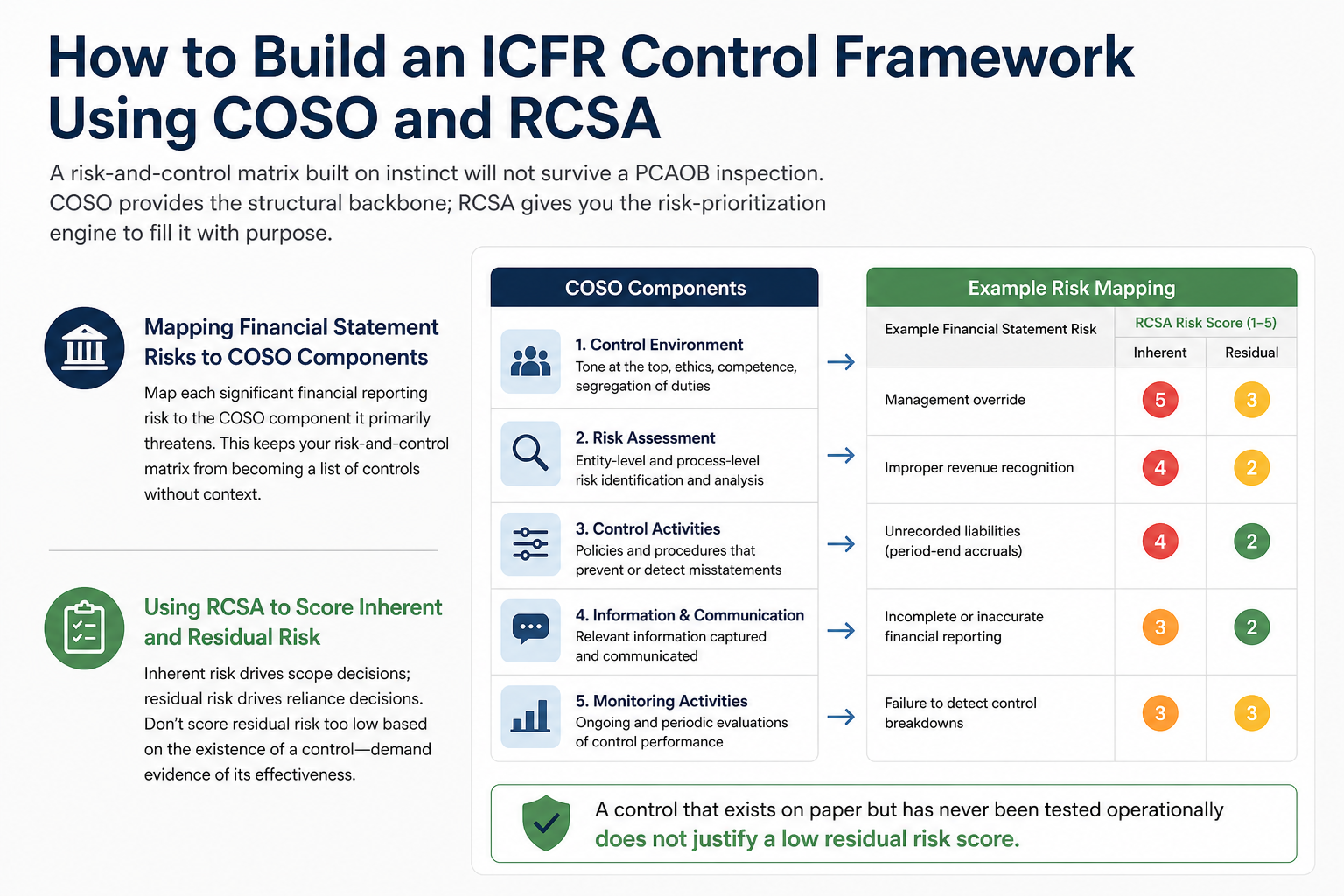
A risk-and-control matrix built on instinct will not survive a PCAOB inspection. COSO provides the structural backbone; RCSA gives you the risk-prioritization engine to fill it with purpose.
Mapping Financial Statement Risks to COSO Components
COSO's five components—Control Environment, Risk Assessment, Control Activities, Information and Communication, and Monitoring—translate directly into audit evidence categories. Control activities are where most ICFR testing happens, but gaps in the control environment (tone at the top, competence, segregation of duties) often explain why control activities fail.
Map each significant financial reporting risk to the COSO component it primarily threatens. A risk of management override maps to control environment. A risk of unrecorded liabilities maps to control activities around period-end accruals. This mapping keeps your risk-and-control matrix from becoming a list of controls without context.
Using RCSA to Score Inherent and Residual Risk
The RCSA framework (risk and control self-assessment) scores risks before controls are applied (inherent risk) and after controls are considered (residual risk). The critical distinction: inherent risk drives scope decisions; residual risk drives reliance decisions.
Audit teams miscalibrate most often by scoring residual risk too low based on the existence of a control rather than evidence of its effectiveness. A control that exists on paper but has never been tested operationally does not reduce residual risk. Treat it as untested until you have operating effectiveness evidence.
Practical example using revenue recognition: inherent risk is high because of judgment involved in contract modifications and variable consideration. If the entity's control is a quarterly management review of contract terms without documented criteria for what triggers escalation, residual risk remains high. That control requires design remediation before you test it for operating effectiveness.
ICFR deficiencies in PCAOB inspections frequently trace back to exactly this point: auditors relied on controls they had not confirmed were adequately designed. The risk-based methodology is only as strong as the inherent-to-residual risk discipline behind it.
Building the Risk and Control Matrix: What Must Be in Each Column
A defensible risk-and-control matrix needs at minimum: process area, financial statement assertion at risk, control description, control owner, control frequency, control type (preventive or detective), inherent risk rating, residual risk rating, and test status.
Do not include control objectives written so broadly that any control could satisfy them. Each control should address one specific risk to one specific assertion. Broad control objectives produce broad, untestable workpapers.
ICFR Audit Testing: A Step-by-Step Approach for Design and Operating Effectiveness
Jumping straight to operating effectiveness testing is the most common sequencing error in SOX testing. A control that is poorly designed cannot be made effective by testing it repeatedly. Follow this sequence precisely.
1. Assess design effectiveness before you test a single transaction. Confirm the control is designed to prevent or detect the specific risk it is assigned to. Walk through the control with the control owner, obtain the control documentation, and assess whether it addresses the right assertion at the right point in the process. A control mapped to the wrong risk will pass operating effectiveness testing and still produce a material misstatement.
2. Set sample sizes based on control frequency and risk rating. Higher-frequency controls (daily, weekly) require larger samples than quarterly or annual controls. Adjust upward for high residual risk ratings. Use a consistent, documented sampling methodology rather than selecting samples by intuition. Audit staff rebuilding sample size calculations each engagement from blank Excel files is one of the most avoidable time costs in SOX compliance procedures.
3. Gather and tie evidence without losing the audit trail. Each piece of evidence must be tagged to a specific control attribute and a specific test objective. The moment evidence lives in an inbox, a shared drive, and a workpaper simultaneously with no cross-reference, the audit trail is already broken.
This is where most audit teams lose the most time. Manually matching evidence to control attributes across spreadsheets, with no automated linkage, creates reconciliation errors and review delays. Finspectors' AI-native audit workspace automates evidence ingestion and matching against control objectives, with ML risk scoring applied across 100% of transactions rather than a sample. Workpapers are generated in real time from testing results, so by the time you reach Step 4, exceptions are already flagged and documentation is review-ready.
4. Document exceptions and escalate material weaknesses promptly. Every exception requires a documented root cause, not just a description of what happened. Determine whether the exception represents a control deficiency, a significant deficiency, or a material weakness using a consistent severity framework. Escalate immediately when a material weakness is identified. Late escalation compounds the deficiency finding with a process failure.
SOX Certification Requirements and What the ICFR Audit Must Support
SOX testing is not complete until the audit outputs can support the specific certifications required under Sections 302 and 404. Understanding who certifies what prevents gaps between the testing record and the signed opinion.
Section 302 Versus Section 404: Who Certifies What
Section 302 requires the CEO and CFO to certify quarterly and annually that they have disclosed all significant deficiencies and material weaknesses to the audit committee and external auditors, and that controls are designed and operating to ensure material information is reported. This is a management certification.
Section 404 requires management to issue an annual assessment of ICFR effectiveness, and for accelerated and large accelerated filers, the external auditor must issue an independent opinion on that assessment. Section 302 certifies disclosure; Section 404 certifies control effectiveness. Both rely on the same underlying testing evidence.
Accelerated Filers, Large Accelerated Filers, and Community Banks: New Thresholds That Change Scope
Effective January 1, 2026, the FDIC's finalized rules under Part 363 adjusted the asset thresholds that determine which institutions require independent audits and attestations under that regulation. Community banks near the previous thresholds should reassess whether their ICFR obligations have changed.
Practically, this means audit leaders at affected institutions should revisit their scoping decisions before the next engagement cycle, not after. If a bank has moved below the new threshold, the scope of required ICFR attestation may narrow. If it remains above, the prior scope holds and the audit plan should reflect any changes in the control environment since the last cycle.
What the ICFR Opinion Must Be Supported By
The external auditor's Section 404(b) opinion must be supported by sufficient evidence of both design and operating effectiveness across all in-scope controls. That evidence must be documented in workpapers that are complete, cross-referenced, and reviewable by a PCAOB inspector without verbal explanation.
Opinion support is not a year-end exercise. Evidence gaps identified at sign-off reflect a testing execution failure, not a documentation shortcut opportunity.
The Most Common ICFR Audit Deficiencies—and How to Close Them Before the PCAOB Does
PCAOB inspections have consistently identified ICFR-related audit deficiencies as the most frequent findings across firm sizes. Most of these findings are identifiable before filing if the audit team applies a structured pre-filing review.
Top Deficiency Categories from PCAOB Inspection Reports
The recurring deficiency categories include: insufficient testing of management review controls, over-reliance on the work of others without adequate evaluation, failure to test the complete population of a control (particularly for IT-dependent controls), and scope gaps in entity-level controls. IT SOX testing deficiencies have increased as companies rely more heavily on system-generated reports and automated controls that auditors have not independently validated.
Why Management Review Controls Fail Testing More Than Any Other Control Type
Management review controls (MRCs) fail testing most frequently because they are designed and documented at a level of abstraction that makes operating effectiveness impossible to evaluate. A control described as "management reviews the financial statements monthly" provides no testable criteria: what triggers an exception, what is the threshold for escalation, who performs the review, and what evidence is retained?
Most SOX audit tutorials focus on transactional controls and skip MRC testing entirely. That gap is exactly what PCAOB inspectors find. For each MRC, your test plan must capture the review criteria, the evidence of investigation when variances appear, and the sign-off with date.
A Pre-Filing Review Checklist for ICFR Workpaper Completeness
Use this checklist the day before sign-off:
- Each control workpaper references a specific risk and assertion from the risk-and-control matrix
- Design effectiveness conclusion is documented separately from operating effectiveness testing
- Sample selection rationale is documented, including the population size and selection method
- Every exception has a documented root cause and severity conclusion
- Management review controls include the specific criteria used by the reviewer, not just evidence that a review occurred
- IT-dependent controls include evidence that the system-generated report was tested for completeness and accuracy
- Entity-level controls have been evaluated for their effect on the scope of transactional control testing
- Sign-off dates on workpapers match the testing period, with no backdated approvals
Conclusion
You now have the scoping logic, the COSO-RCSA framework, the testing sequence, and the pre-filing checklist. The methodology is clear. What determines whether it executes cleanly is the infrastructure behind it.
Teams running ICFR audits on disconnected spreadsheets, manual evidence matching, and rebuilt workpaper templates spend most of their bandwidth on administration rather than judgment. That is where audit quality erodes and timelines stretch. The auditors who will run defensible, efficient ICFR engagements going forward are the ones pairing sound methodology with tooling built for it.
See how Finspectors automates ICFR evidence testing and workpaper generation. Request a demo tailored to your audit cycle.